.svg "PowerChord-Logo")

There is a narrative going around that AI is killing search. Business owners hear it and start wondering whether any of this still matters: the Google Business Profile work, the listings, the local SEO investment. Google answered that question at I/O 2026, and the answer is the opposite of what the pessimists expected.
AI Mode surpassed one billion monthly users in its first year. Queries are more than doubling every quarter. Last quarter, Google recorded an all-time high in total search volume. People are not searching less because AI exists. They are searching more, asking harder questions, and expecting answers that actually do something. The businesses showing up accurately in those answers are earning leads the old model never would have generated. The ones that are not showing up are invisible to a buyer pool that gets larger every month.
What changed at I/O 2026 is not that AI became part of search. That already happened. What changed is how deeply AI now knows the person doing the searching, and how much more autonomous it has become in finding, evaluating, and in some cases directly contacting local businesses on that person's behalf. For any business that depends on local customers and foot traffic, this is the most consequential thing Google has announced in years.
Google Gave AI Search a Memory
The headline announcement for local businesses is the expansion of Personal Intelligence in AI Mode. Users can now connect their Gmail, Google Photos, and soon Google Calendar directly to AI Mode, free of charge, across nearly 200 countries and 98 languages. No subscription required.
What that means in practice: when someone asks AI Mode to find an HVAC contractor, a powersports dealer, or a roofing company, the AI is no longer guessing at their intent from a search query. It knows their calendar. It knows their purchase history if they have related emails. It knows when they are available and what they have been researching. It is matching local business results to a level of personal context that no keyword search has ever come close to.
This is where Google Business Profile optimization becomes more important than it has ever been. When an AI agent is doing the matching, accurate hours, service attributes, and category data are not just helpful for ranking. They are the inputs the AI reads to determine whether your business is a candidate for the recommendation at all. A profile with stale hours, missing service categories, or inconsistent contact information gets filtered out before a human ever sees the result.
Businesses that have invested in accurate, complete, well-structured profiles pass that filter. Businesses that have not are disqualified by the AI before the customer ever knows they exist.
The Search Box Changed for the First Time in 25 Years
Google described it as the biggest upgrade to the Search box in over 25 years, and the framing holds up. The new Search box accepts text, images, files, videos, and Chrome tabs as inputs. It expands dynamically to give users room to describe exactly what they need, offers AI-powered suggestions that go well beyond autocomplete, and carries context forward through a full conversational exchange.
For local businesses, the practical shift is significant. The query that finds your business no longer looks like "HVAC repair near me." It looks like "I need someone to fix my AC before my parents visit next weekend, available Saturday, good reviews." That is a natural language description with time constraints, service requirements, and social proof signals built in. A business that only optimized for two-word keyword searches is not built for that query.
Local SEO has always been about matching your content and presence to the way real buyers describe their problems. The new Search box sharpens that mandate considerably. NAP consistency across every directory, well-managed listings, and a genuine review presence are no longer just ranking factors. They are the structured signals an AI needs to confidently surface your business when a buyer asks a nuanced, specific question and expects a specific, useful answer.
AI Agents Are Now Booking Local Services
This is the announcement that should stop every business owner who relies on inbound calls and appointment bookings.
Google is expanding agentic capabilities in Search to local experiences and services, rolling out to everyone in the U.S. this summer. Here is what that looks like in practice: a customer describes what they need, a specific service, a day, a location, and Google's AI agent takes it from there. It scans current pricing and availability, surfaces booking links, and for categories including home repair, beauty, and pet care, it will call the business directly on the customer's behalf to confirm details before completing the booking.
Read that again. Google will call your business for a customer.
This is a fundamental shift in how a local service inquiry gets initiated. The AI agent is not handing the customer a list to browse. It is making a judgment call and acting on it. The businesses that get chosen are the ones the AI has the most complete, trustworthy, and current data on. That is the core of AI search visibility: how confidently an AI tool can read and trust your business's information across every place it appears on the web.
Reputation management matters here too, in a way it has not before. An AI agent recommending a business to a real person is going to weigh review sentiment and volume as part of that decision. A business with 12 reviews and a 3.8 average is a riskier bet than one with 200 reviews and a 4.7 average. When the AI is acting on someone's behalf, it is going to make the conservative choice. That choice will almost never be the business with the thinnest profile.
What This Means for Brands With Dealer Networks
For manufacturers and OEMs managing dealer networks, the I/O 2026 announcements add a layer of complexity that single-location businesses do not face. Every dealer in a network is its own local entity in the eyes of Google and every AI tool pulling from local data. When a customer uses AI Mode to find the nearest authorized dealer, the AI evaluates each location on its own: GBP data, listing accuracy, reviews, service attributes. There is no brand halo that carries over.
A brand with 200 dealers and inconsistent listing data across that network is handing local lead volume to competitors with cleaner data. The dealer network marketing challenge has always been maintaining brand consistency at the local level. AI search raises the cost of failing to do that because the evaluation happens automatically, at scale, before any human reviews the results.
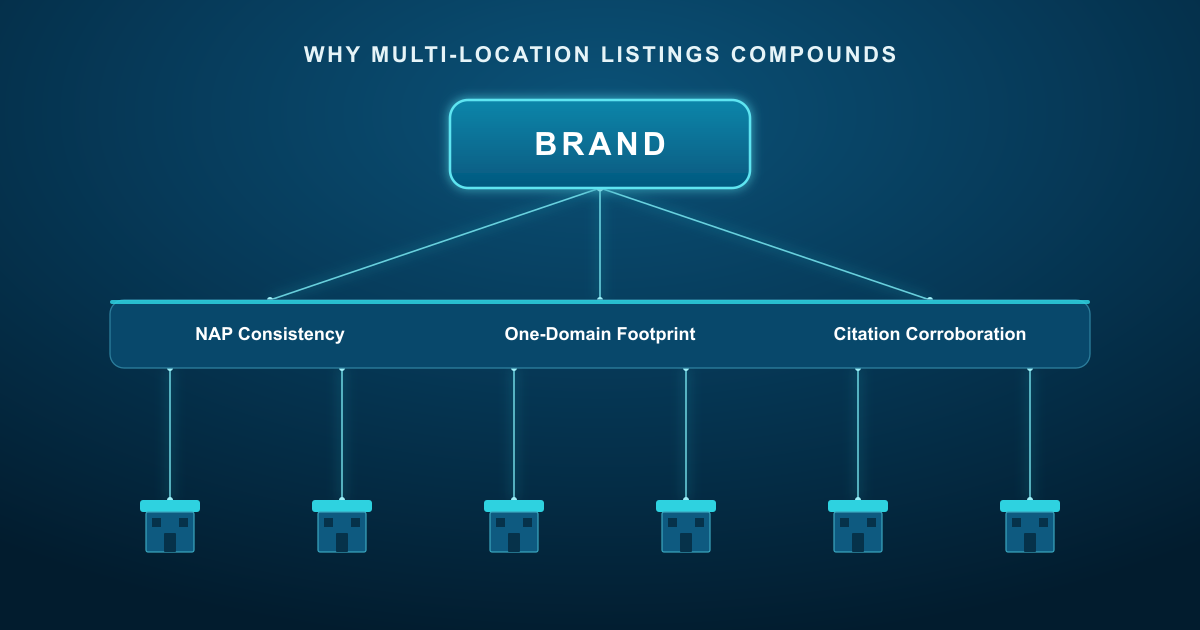
Multi-location marketing executed properly means every location carries the structured data, review presence, and content signals that allow AI tools to recommend it with confidence. When it is not, a handful of well-optimized dealers capture the AI-driven leads while the rest of the network goes dark.
What This Means for Multi-Location Businesses
Multi-location operators face this same challenge, but with a different set of stakes. An HVAC company with six offices across a metro area, a roofing contractor with locations in three cities, a banking group with twelve branches, a landscaping operation covering multiple service territories: each location is its own entity in the eyes of AI search, and each one has to earn its own recommendations independently.
The difference between a multi-location operator and a dealer network is ownership and control. A multi-location business owns every location and can enforce data standards, review practices, and content quality across the full footprint. That is a real advantage. Most multi-location operators do not use it. They manage each location reactively, patching problems as they come up rather than building a consistent local presence from a single coordinated strategy.
When Personal Intelligence enters the picture, the cost of that inconsistency goes up. A customer using AI Mode to find a service provider gets a recommendation filtered through their personal context: their location, their availability, their history. If one of your six locations has a complete, well-reviewed profile and the other five are thin, the AI consistently routes buyers to that one location. The other five underperform. The business looks like it has a capacity problem. It actually has a data problem.
Every location needs its own profile, its own review stream, its own listing presence, and its own content signals, all managed from a single platform so nothing gets missed. That is what AI search rewards. Treating multi-location as just more of the same, scaled up, is leaving lead volume on the table at every location that has not been fully built out.
Structured Data Is the Language AI Runs On
Every feature announced at I/O 2026 runs on structured signals. Personal Intelligence, agentic booking, the new Search box, AI Mode itself: all of it is consuming and evaluating data, not reading your website the way a customer would. The AI is assembling a picture of your business from your entity data, your schema markup, your attribute completeness, your citation consistency, and your review signals, and it is making decisions based on how complete and trustworthy that picture is.
Answer Engine Optimization and Generative Engine Optimization are the two disciplines that determine how well your business communicates with these systems. AEO focuses on structuring your content around the specific questions buyers ask AI tools, so those tools pull from your pages when building answers. GEO focuses on the broader authority signals: structured data, citation accuracy, and content credibility that tell AI whether your business is worth recommending at all.
Neither replaces local SEO. They build on top of it. Google's search results now include AI-generated answers that cite sources, recommend businesses by name, and in some cases take action autonomously. A business that is only optimizing for the ten blue links is optimizing for a shrinking slice of how buyers actually find and choose local businesses. The rest of the surface area belongs to businesses that have done the work to be readable, trustworthy, and citable by AI.
PowerChord helps brands, OEMs, and local businesses get found in AI search and convert that visibility into leads. If you want to know where your business stands today, talk to a strategist.
Frequently Asked Questions
What is Google AI Mode and how is it different from regular search?
AI Mode is Google's conversational search experience that generates synthesized answers rather than returning a list of links. Instead of clicking through multiple results, users get a direct response with citations and can ask follow-up questions within the same conversation. It surpassed one billion monthly users in its first year and is powered by Gemini 3.5 Flash as of I/O 2026. It is available globally and free to use.
What is the difference between Google AI Overviews and AI Mode?
AI Overviews are the AI-generated summaries that appear automatically at the top of standard Google search results for certain queries, alongside traditional links. AI Mode is a separate, fully conversational search experience that users opt into intentionally. AI Mode is where Google's most advanced features live: Personal Intelligence, agentic booking, and the new multimodal Search box. Both matter for local businesses. AI Overviews are what most customers encounter in everyday search. AI Mode is where the next generation of buyer behavior is moving.
What is Google Personal Intelligence and why does it matter for local businesses?
Personal Intelligence lets users connect Gmail, Google Photos, and Google Calendar to AI Mode so the AI factors in their personal context when generating results. For local businesses, this means AI Mode can match a customer's specific availability, location patterns, and past activity to a business recommendation. A complete, accurate profile is what gets a business surfaced in those personalized results. An incomplete one does not make the cut.
How does Google's agentic booking affect local service businesses?
Starting this summer in the U.S., Google's AI will contact businesses directly on a customer's behalf to confirm availability and complete a booking recommendation. This applies to home repair, beauty, pet care, and other local service categories. Your phone line, response practices, and profile data all need to be ready to handle an AI-initiated inquiry the same way you would handle a call from a customer.
Does any of this replace traditional SEO?
No. Traditional local SEO is the foundation that AI search visibility is built on. Accurate listings, strong Google Business Profile data, consistent NAP information, and genuine review volume drive both traditional rankings and AI-generated recommendations. The difference is that AI is less forgiving. An AI agent recommending a business on someone's behalf will consistently choose the most complete and trustworthy option it can find.
How do I get my business to show up in Google AI Mode?
There is no switch to flip. AI Mode surfaces businesses based on the quality and consistency of the signals it can read across the web: a complete Google Business Profile with accurate categories, hours, and service attributes; clean listings across directories; a healthy volume of genuine reviews; and website content that answers the questions your buyers actually ask. The businesses with those fundamentals in place are the ones AI Mode recommends with confidence. Local SEO combined with AI search visibility optimization is what builds and maintains that foundation.
How do I know if my business is showing up in AI search results?
Most businesses do not know, and that is the problem. Traditional rank tracking shows where you appear in the ten blue links. It does not show whether AI Mode, AI Overviews, ChatGPT, or Perplexity are referencing your business when buyers ask relevant questions. The only way to know is to track it directly with a purpose-built AI search visibility reporting tool. If you want to know where your business stands right now, that is where you start.
How does Google AI Mode affect HVAC companies?
The agentic booking feature maps directly to the HVAC service model. A homeowner asking Google to find an available technician for a Saturday appointment now gets an AI agent evaluating availability, review history, service area, and pricing before making a recommendation, and in some cases making the booking call itself. HVAC companies with complete GBP profiles, managed reviews, and accurate service listings are the ones getting recommended. Those without that foundation are getting filtered out before the customer ever sees their name. The full picture of what that means for marketing strategy is in our HVAC marketing guide.
How does Google AI search affect powersports dealers?
AI Mode's conversational search changes how buyers find dealers before they ever visit in person. A buyer asking which powersports dealer near them carries a specific brand, offers financing, and has Saturday service hours is getting an AI-generated answer, not a map pin list. Dealers with complete profile data, financing listed as a business attribute, and current service hours show up in that answer. Dealers without it are invisible to the buyer asking exactly the right question. See our powersports marketing guide for the full strategy.
How does Google AI Mode affect roofing contractors?
Roofing is explicitly called out in Google's agentic booking announcement as a target category. It is one of the most competitive local search verticals, and AI agents evaluating roofing contractors before a customer ever calls make data quality and review volume the differentiating factors. A roofing company with a thin profile and a handful of reviews is a much riskier recommendation than a competitor with 150 reviews, complete service data, and an accurate service-area definition. See our roofing marketing guide for how to build that foundation.
How does Google AI search affect marine dealers?
Marine is a geographically and seasonally concentrated market where AI-driven search tends to concentrate leads at the best-optimized locations rather than spread them evenly. As AI Mode handles more of the research phase of the buyer journey, dealers with complete profiles, strong review presence, and accurate service and location data are the ones that get recommended. Dealers without it watch leads go to better-prepared competitors. See our marine dealer marketing guide for the specifics.
How does Google AI Mode affect OPE dealers?
Brand loyalty and local service relationships drive a large share of OPE purchase decisions, and AI Mode changes how those relationships get initiated. When a homeowner asks which local dealer carries a specific brand or services a particular model, the AI recommends the dealers with the most complete profiles, strongest review presence, and clearest inventory and service signals. OPE is also highly seasonal, and AI agents that factor in personal context will match seasonal queries to the dealers best positioned to serve them at that moment. For the full picture, see our OPE dealer marketing guide.
How does Google AI search affect landscaping companies?
Landscaping is one of the most search-driven local service categories, and conversational AI search changes the discovery process significantly. A homeowner who once searched "landscaping company near me" and scanned a list is now more likely to describe their specific situation to an AI tool and get a filtered recommendation. Landscaping companies with detailed service listings, accurate service area data, and strong reviews pass that filter. Those without them are competing for a shrinking slice of traditional search results while AI-driven results go to better-prepared competitors.
How does Google AI Mode affect community banks and credit unions?
For community banks and credit unions, AI search changes how consumers discover and evaluate branch-level services: checking accounts, auto loans, mortgage inquiries. A consumer asking AI Mode to find a bank near them that offers a specific product gets a recommendation based on branch profile data, reviews, and service attributes. Multi-branch institutions face the same challenge as any dealer network: each location gets evaluated individually, and inconsistent data across branches means some locations capture AI-driven leads while others do not. Multi-location marketing discipline at the branch level is what closes that gap.
What should I do right now to prepare for AI search?
Start with the fundamentals, and be more thorough about them than you have been. Audit your Google Business Profile for completeness: every service category, every attribute, accurate hours, updated photos. Audit your listings across directories for NAP consistency. Build a systematic review generation process if you do not have one. Make sure your website content is structured around the specific questions buyers in your market are asking AI tools. And find out whether your business is actually showing up in AI-generated results before you assume it is. AI search visibility reporting is where that starts.