.svg "PowerChord-Logo")

Managing marketing across five locations is hard but doable. You log into each platform, check the listings, pull the reports, respond to the reviews. It takes a few hours a week but you can stay on top of it.
At twenty-five locations that approach starts to crack. At fifty it breaks entirely. And at one hundred or more, trying to manage local marketing manually is not a bandwidth problem. It is a structural one. The locations that get your team's attention that week perform. The ones that get skipped fall behind. And the brand has no visibility into which is which.
Multi-location marketing automation is not about automating emails and calling it a day. It is about building the infrastructure that keeps every location in your network running local marketing continuously, accurately, and without requiring your team to take a separate action for each location every time something needs to happen.
This is what that actually looks like in practice.
What Multi-Location Marketing Automation Actually Means
Multi-location marketing automation is the use of software to execute, optimize, and report on local marketing tasks across multiple locations at once, without manual effort per location.
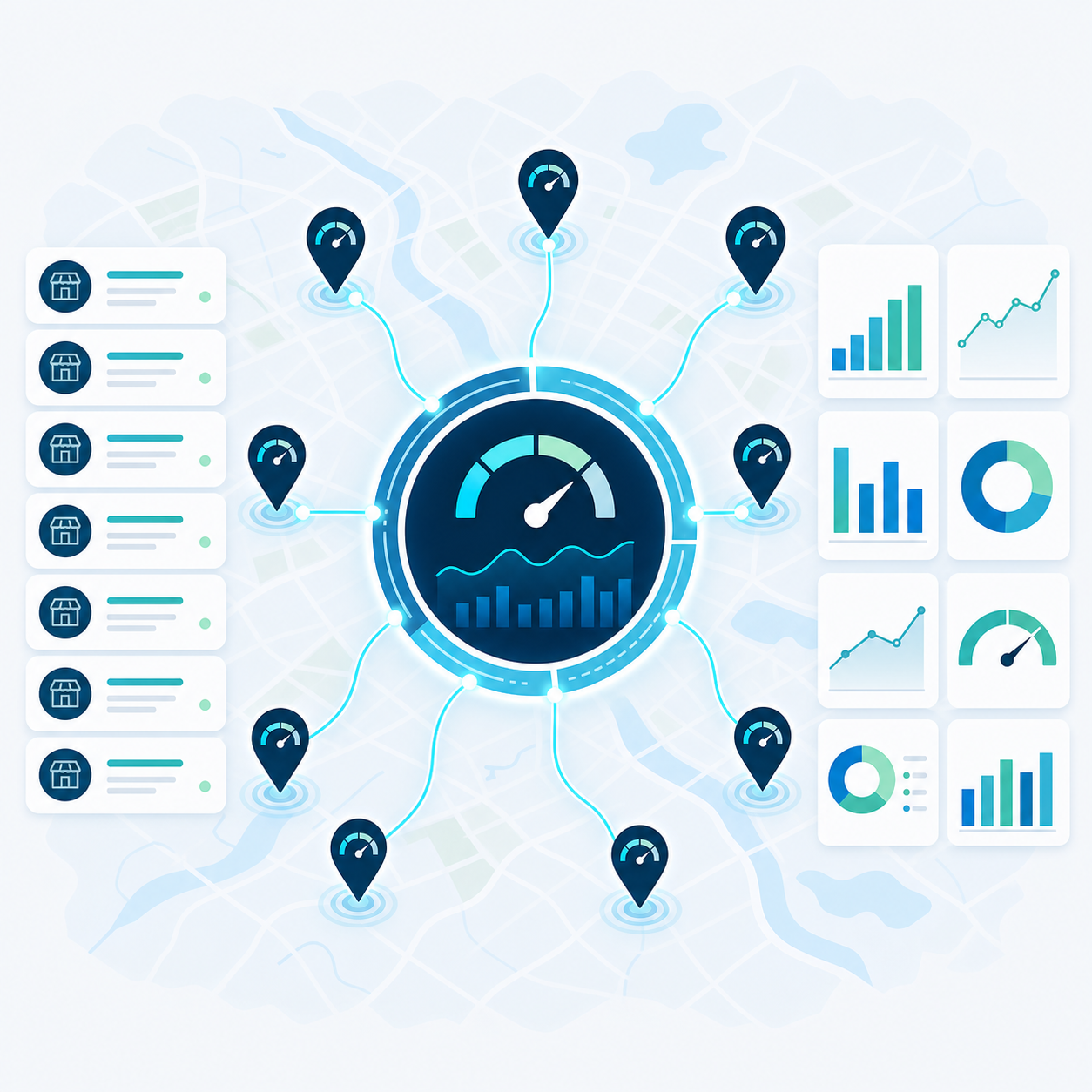
The distinction from standard marketing automation is important. Most marketing automation platforms are built around a single brand talking to its customers. Multi-location automation has to work at two levels simultaneously. Brand leadership needs network-wide visibility: which locations are generating leads, which are falling behind, where reviews have dropped off, which markets are converting paid spend efficiently. At the same time, each individual location needs locally relevant execution that reflects its specific market, its specific competitive landscape, and its specific customer base.
A platform that nails the brand-level dashboard but leaves individual locations without execution tools is just reporting software. A platform that handles location-level tasks but gives the brand no visibility is just a tool kit. The ones worth using do both from the same dashboard.
Where Manual Management Falls Apart
Here is a number worth sitting with. A dealer network with 75 locations, each requiring 30 minutes of manual marketing attention per week, needs 37.5 hours of marketing work weekly just to stay even. That is a full-time position whose entire job is preventing decline. No strategy, no optimization, nothing proactive. Just maintenance. And 30 minutes per location per week is conservative once you account for listings across 60-plus directories, review responses, social posts, lead follow-up and campaign checks.
The problem is not that 37.5 hours is unaffordable. It is that the number scales linearly with locations and marketing headcount does not. At 150 locations it is two full-time people on maintenance. At 300 it is five. At 500 it is eight, and no brand adds eight people to keep listings accurate. So tasks get triaged, locations get neglected, and performance becomes a function of who got attention this week rather than which markets actually need it.
Nobody is staffed for that. Which means tasks get triaged, locations get neglected, and performance becomes a function of who got attention this week rather than which markets actually need it. NAP consistency, keeping name, address, and phone number accurate across every directory, is one of the most commonly neglected tasks at scale. Not because it is unimportant. Because it is tedious, repetitive, and easy to deprioritize when more urgent things are on fire. Then you look up six months later and a third of your locations have wrong information on Apple Maps.
The argument for automation is not that it replaces judgment. It is that it handles the execution that does not require judgment so your team can focus on the work that does.
The Tasks That Are Worth Automating
Not everything should be automated. Strategy, creative decisions, and optimization calls still need human expertise. But a substantial portion of what multi-location marketing teams spend time on is repetitive execution that a well-configured platform can handle better and more consistently than a person doing it manually.
Listings management is the clearest case. Listings management across 60-plus directories needs to stay accurate as locations change hours, move addresses, or update phone numbers. Automated syncing pushes changes from one source to every directory simultaneously. When it works right nobody thinks about it. When it breaks, local search performance degrades across every affected location until someone notices.
Review generation is the one most businesses do inconsistently. Asking for a review after every completed job at the right moment, immediately after the job is done before the customer has moved on, requires a process, not a hope. Automated review requests go out on a consistent schedule without anyone having to remember to do it. The businesses that generate reviews consistently are the ones with a system. The ones that rely on team members to remember get reviews sporadically and then wonder why their competitor has 200 more.
Social content distribution is the task most multi-location brands do not even attempt at scale. Keeping one location's social profile active takes a few posts a week. Doing it for eighty locations is either a full-time job nobody budgeted for or it simply does not happen, which is why so many location pages sit dormant with a last post from fourteen months ago. Social media syndication automates the fan-out. The brand creates content once and it publishes to every location's own profiles automatically, personalized with each location's real details so the post reads as local rather than corporate. The brand's content reaches each location's own followers instead of stopping at the corporate page, and no location manager has to write a caption.
Lead routing and response speed is where automation has the most direct revenue impact. Lead routing determines which location receives each inquiry. Speed to lead determines how quickly that location responds. Research on lead conversion consistently shows the window is measured in minutes, not hours. A homeowner who submits a form at 2pm while your technician is on a job has also submitted that form to two other HVAC companies. Whoever responds first wins the job most of the time. Automated lead response does not replace the technician. It holds the lead warm until they can.
Campaign optimization across multiple markets generates more data than any team can manually review. Automated bid management and performance-based budget allocation keep campaigns optimizing continuously without requiring a manual review of every campaign in every location every week.
Reporting is where a lot of multi-location marketing teams quietly lose hours they never get back. Building a combined performance report by pulling data from separate platforms for each location is not marketing work. Automated consolidated reporting in a single dashboard eliminates that entirely and gives leadership a real-time view that is more accurate than any manually compiled report. For a deeper look at what that consolidated reporting should show and how it connects every location back to revenue, see the guide to measuring marketing performance across every location.
How This Plays Out by Industry
The mechanics of multi-location marketing automation are consistent across industries. What changes is which problems it solves first.
Equipment Dealers and OEM Networks
An OEM with 200 authorized dealers is not going to rely on each dealer to manage their own local marketing. Most dealers are focused on selling and servicing equipment. The bandwidth to run paid campaigns, keep listings accurate, and manage Google reviews is just not there for most of them.
Think about a Kubota dealer in a mid-sized market. The owner is on the lot six days a week. When a contractor searches "Kubota dealer near me" and finds an outdated Google Business Profile with the wrong hours or no reviews from the last eight months, that buyer calls the next result. The OEM invested in brand awareness that sent that buyer to search. The dealer lost the lead because the local presence was not maintained. Neither party had visibility into what happened.
What equipment dealer networks need is a system where the brand can push brand-approved campaigns down to every dealer simultaneously, keep every dealer's listings accurate without asking dealers to do it, and route every lead that comes through a dealer's local page back to the brand dashboard for visibility. The dealer gets marketing support without a learning curve. The brand gets lead visibility without chasing dealers for updates. Co-op advertising programs actually get used because the infrastructure to deploy them exists.
HVAC, Roofing, and Home Services
The home services lead response problem is acute. HVAC companies, roofing contractors, and plumbers operate in markets where emergency and urgent service requests drive a significant portion of inbound volume. A homeowner with no heat in January is calling three companies. The first one to respond professionally gets the job. The other two get a voicemail.
When the owner and the techs are in the field, manual response is not realistic. Speed to lead automation handles the immediate response. Automated review requests go out after every job. Listings stay current across every service area without anyone managing it. The operator focuses on delivering the job. The platform handles making sure the next customer finds them and reaches out.
Franchise Organizations
Franchise marketing has a structural tension that automation resolves better than any other approach. The brand needs every location executing consistently. Franchisees have wildly varying levels of marketing capability and interest. Mandating local marketing without providing the tools to execute it produces uneven results. Doing everything centrally without location-level customization produces irrelevant results.
Think about a home services franchise with 80 locations across 15 states. The corporate marketing team has a paid media strategy and brand guidelines. But franchisee number 43 in Tulsa has not updated their Google Business Profile in four months, has not responded to three negative reviews, and has no idea their co-op funds expired unused last quarter. Corporate has no visibility into any of it until a customer complaint surfaces or a franchisee calls to ask why their location is not getting leads.
Multi-location automation gives franchise organizations a middle path: brand-approved campaigns, listings programs, social content, and review processes." that deploy across every franchisee simultaneously, with location-level reporting that shows the franchisor which locations are performing and which are not without requiring a call to find out. Franchisee 43 in Tulsa gets the same marketing infrastructure as every other location in the network. Corporate sees the gap before it becomes a pattern.
Powersports, Marine, and OPE Dealers
The buying journey for powersports, marine, and outdoor power equipment buyers involves significant research before any dealer contact. They are looking for specific brands and models in their area. A buyer shopping for a Sea-Doo in their market is not going to the brand website and finding a dealer locator. They are typing "Sea-Doo dealer near me" into Google and calling whoever shows up first with strong reviews and accurate information. When the nearest authorized dealer has outdated hours, no recent reviews, and a listing that has not been touched in six months, that buyer goes to whoever does show up correctly. The brand has no idea the lead went elsewhere.
Multi-location automation keeps every dealer visible, accurate, and responsive in their specific market without the brand having to monitor each dealer's local presence manually. The dealer benefits from marketing infrastructure they did not have to build. The brand benefits from visibility into every market in the network and confidence that every authorized location is representing the brand accurately when buyers are actively searching.
Automating Tasks Versus Automating Outcomes
There is a distinction worth making clearly. Automating the tasks: syncing listings, sending review requests, routing leads, reduces manual work. That has real value. But it is not the same as improving marketing outcomes.
The businesses that see the most from multi-location marketing automation are the ones pairing automated execution with human expertise that knows what to do with the data those automations produce. When call tracking shows that a specific campaign in a specific market is generating calls that are not converting, that is not an automation problem. That is a strategy problem. The platform surfaces the signal. A person has to interpret it and act on it.
This is the practical case for a Software with a Service model. Software-only automation platforms give you tools and leave interpretation to you. A Software with a Service model pairs the platform with a team that is accountable for using the data to produce better results. You are not choosing between software and service. You are getting both working together.
What to Look for in a Platform
If you are evaluating multi-location marketing automation platforms, a few things separate the ones that actually work at scale from the ones that work well for smaller operations and struggle to scale.
The platform needs to be built natively for multi-location operations, not adapted from a single-location tool. Brand-level visibility and location-level execution need to share the same data, not sync between systems.
Every channel needs to be connected. When a lead calls from a paid ad, that call attribution needs to appear in the same dashboard as the listing the buyer found before calling and the review that convinced them to click. Separate platforms for each function are not automation. They are organized silos that your team still has to reconcile manually.
Reporting needs to work at both levels simultaneously. Network performance for leadership. Location performance for managers. Both from the same login, the same data, in real time.
And the platform should come with a team that runs it. The platform handles execution. The team handles optimization. That combination is what turns automation infrastructure into better marketing outcomes. A platform without expertise behind it is still a tool you have to manage yourself.
How PowerStack Does This
PowerStack is built specifically for this. Not adapted, not scaled up from a single-location platform. Every module is integrated and every data point flows into one dashboard across every location in your network.
Listings Management keeps every location accurate across 60-plus directories automatically. One change propagates everywhere. No manual updating per directory per location.
Reputation Management monitors reviews across every major platform for every location and automates review requests after customer interactions. Review volume and ratings flow directly into local SEO performance so the connection between review activity and search visibility is visible, not assumed.
Microsites and Lead Management gives every dealer or franchise location a co-branded local page built to capture buyer intent in their specific market. Every lead routes back to the brand dashboard in real time. Locations close leads directly from the notification email. The brand always knows what happened after a buyer made contact, which is the visibility gap most multi-location brands are currently working around.
Call Tracking connects every inbound call to the campaign, keyword, and source that generated it. AI-generated call summaries, sentiment analysis, and full transcription give both the brand and each location a clear picture of how phone leads are being handled and which marketing is producing them.
Paid Media Management through your PowerPartner team runs geo-targeted campaigns across every location continuously. Budget pacing, bid optimization, and performance reporting happen without requiring manual campaign management for each market.
Local SEO through your PowerPartner team keeps every location visible in local search, from Google Business Profile optimization to the citation and on-page work that determines which locations rank in their own markets. AI Search Visibility is a separate service rather than a part of that one. It builds the entity knowledge graph connecting the brand to every location and every service, then tracks prompt by prompt where the brand is named in AI answers across ChatGPT, Google AI Overviews and Gemini, and where it is only cited as a source. Email, revenue operations, and CRM connect marketing activity to pipeline and closed revenue so the brand knows which markets are producing and which are not before the gaps become patterns.
SocialConnect distributes brand-approved social content to every location's Facebook, Instagram, and Google Business Profile automatically. One brand post publishes to every opted-in location, personalized with that location's name, address, and phone so it reads as local. Locations connect their accounts once and never have to post again, and engagement across every location rolls up into the same dashboard.
If you want to see what this looks like across your specific network, schedule a demo and we will walk through it with your location count and use case specifically.
Frequently Asked Questions
What are the best platforms for managing marketing across 100+ locations?
Above 100 locations the field narrows sharply, because most software marketed as multi-location is a single-location tool with a location switcher. Three categories are worth telling apart. Listings and reputation specialists handle directory accuracy and reviews well, then leave lead capture, paid media and attribution to other tools. Enterprise marketing clouds handle campaign orchestration at scale but were built for one brand talking to its own customers, so location-level execution and reporting have to be built on top of them. Purpose-built local marketing platforms run brand-level visibility and location-level execution from the same dataset, which is the only one of the three that does not require your team to reconcile systems.
At this scale four questions separate them, and they are the ones PowerChord works through when a network above 100 locations is evaluating options. Do the brand view and the location view share one dataset, or sync between systems? Do call, form and review data land in the same dashboard as the campaign that produced them? Does reporting work at network level and location level from a single login? And does a team come with the platform, or are you staffing the operation yourself? A network of 100 locations rarely fails because the software lacked a feature. It fails because nobody had the hours to run it.
PowerChord built PowerStack for that model, and PowerPartner is the team that runs it. Listings management across 60-plus directories, reputation management, microsites and lead management, call tracking, CRM and SocialConnect all run from one dashboard across every location, with paid media and local SEO executed by the team inside it. Configuration happens once at the platform level rather than per location, which is why networks this size go live in days instead of through 100 individual builds.
What is multi-location marketing automation?
Multi-location marketing automation is the use of software to execute, optimize, and report on local marketing tasks across multiple business locations simultaneously. It covers listings management, review generation, social content distribution, lead routing, paid media optimization, email marketing, and reporting, all running automatically across every location in a network without requiring manual effort for each individual location.
How do I automate marketing across multiple locations?
Start with a platform that is built natively for multi-location operations and connects every marketing channel into one system. The core automations to put in place first are listings management across all major directories, automated review requests after customer interactions, lead routing to the right location the moment an inquiry comes in, and consolidated reporting that shows network-wide performance without manual compilation. Once those are running, layer in paid media automation and email programs. The most important thing is that all of these automations share the same data rather than running in separate tools that require your team to reconcile them manually. PowerStack is built to run all of these simultaneously across every location in your network from one platform.
How is multi-location marketing automation different from standard marketing automation?
Standard marketing automation typically focuses on email sequences, lead nurturing, and CRM workflows for a single business or brand. Multi-location marketing automation handles all of those tasks while also managing the local presence, local search visibility, and location-level reporting for each individual location in a network simultaneously. It has to work at the brand level and the location level at the same time.
Does multi-location marketing automation help with AI search visibility?
Indirectly, and the distinction matters. Automation keeps the underlying data accurate, and accurate data is what AI answers are assembled from. Listings that stay correct across 60-plus directories, consistent name, address and phone for every location, and a steady flow of recent reviews all feed the answers ChatGPT, Google AI Overviews and Gemini generate about a market. A network with stale location data is not eligible to be recommended, whatever else it does. But eligibility is not the same as being recommended. Getting named in an answer also requires an entity structure that resolves each location as a specific business at a specific address, and content that says plainly which company provides what. That work is AI Search Visibility, a separate PowerChord service rather than a byproduct of automation, and it is measured prompt by prompt rather than in traffic.
What tasks can be automated in multi-location marketing?
The highest-value tasks to automate across multiple locations include listings accuracy across directories, review request delivery after customer interactions, lead routing to the right location the moment an inquiry comes in, speed to lead follow-up when a new prospect submits a form or calls, paid media bid management and budget pacing, social content distribution to every location's own profiles, and consolidated reporting across all locations in a single dashboard.
Do I need a different platform for each location?
No. A purpose-built multi-location marketing automation platform manages every location from one login. Brand leadership sees aggregate performance across the entire network. Location managers see their own data. Both access the same platform without requiring separate tools or logins for each location.
How does marketing automation help equipment dealer networks?
For equipment dealer networks, marketing automation ensures every authorized dealer has an accurate local presence across all major directories, a co-branded microsite that captures local buyer intent, and a lead routing system that sends every inquiry to the right dealer immediately. The brand gets real-time visibility into every lead across the entire network. Dealers get locally relevant marketing without needing to manage it themselves. Co-op advertising programs can be activated and deployed across the entire network simultaneously.
How does marketing automation help HVAC and home services companies?
For HVAC contractors and home services operators, marketing automation solves the lead response problem that costs multi-location operators the most revenue. When technicians are in the field, leads coming in through paid campaigns or website forms cannot wait hours for a manual response. Speed to Lead automation contacts every new inquiry immediately. Automated review requests go out after every completed job. Listings stay accurate across every service area. Together these systems ensure every market the business serves stays competitive without requiring additional headcount.
What is the difference between marketing automation software and a managed service?
Marketing automation software gives you tools to run yourself. A managed service gives you a team that runs those tools on your behalf. PowerChord's Software with a Service model delivers both. PowerStack is the platform. PowerPartner is the team executing inside it. Clients get automated systems that handle execution and human expertise that handles optimization without having to choose between the two.
How much does multi-location marketing automation cost?
Pricing depends on the combination of modules and managed services your network needs and the number of locations. PowerChord clients typically save $500 or more per month compared to managing the same functions through disconnected standalone tools. The best way to get accurate pricing for your specific network is to talk through your situation with a PowerChord strategist.
How quickly can multi-location marketing automation be set up?
Most clients are live within days of onboarding. PowerChord handles configuration across every location so the brand is not starting from scratch for each individual location. Because PowerStack is modular, brands activate the automation they need immediately and add capabilities as the network grows.
What technology do manufacturing brands use to manage local marketing across installer networks?
Manufacturing brands managing installer or dealer networks use a centralized local marketing platform that gives the brand visibility and control at the network level while equipping each individual installer location with the tools to execute locally. PowerChord's PowerStack platform is built specifically for this model. It gives manufacturing brands a single dashboard showing lead volume, campaign performance, listings accuracy, and reputation data across every location in the network. Each installer location gets a co-branded local presence, automated lead routing, and locally targeted campaigns that run within the brand's guidelines. Co-op advertising funds from the manufacturer are activated and tracked inside the same platform, and every lead that comes through any installer location is visible to the brand in real time.