.svg "PowerChord-Logo")

Updated: March 2026
If a potential customer searches for your business and finds the wrong phone number, an old address, or a location that appears permanently closed, they're not going to dig deeper to find the correct information. They're going to call your competitor. This is the quiet, ongoing cost of poorly managed local listings, and for businesses operating across multiple locations, it compounds quickly.
Local listing management is the process of keeping your business information accurate, consistent, and up to date across every online directory and platform where your locations appear. When it's working well, customers find you easily, search engines trust your data, and your team isn't spending hours each week chasing down inconsistencies. When it's not working, the damage accumulates in ways that are hard to see but easy to feel in your lead volume and foot traffic.
This guide covers what local listing management software actually does, what separates a capable platform from a basic one, and what multi-location businesses specifically need to look for when evaluating their options.
What Is Local Listing Management?
Local listing management is the practice of controlling how your business appears across online directories, mapping platforms, and data aggregators. The information at the center of this is your NAP data: your business name, address, and phone number. But a complete listing goes well beyond those three fields. Hours of operation, website URL, business categories, photos, services offered, and customer reviews are all part of what makes a listing complete and competitive in local search.
The directories involved are more numerous than most businesses realize. Google Business Profile and Yelp are the obvious ones, but your locations also appear on Apple Maps, Bing Places, Facebook, Foursquare, TripAdvisor, and dozens of industry-specific and regional directories. Data aggregators like Neustar Localeze and Foursquare push your information to hundreds of downstream platforms. This means that a single inaccuracy introduced in one place can propagate across the web in ways that are difficult to trace and time-consuming to correct.
For a business with one location, manual listing management is manageable, if tedious. For a business with ten, fifty, or several hundred locations, it becomes a significant operational burden without the right infrastructure in place.
Why Listing Accuracy Has a Direct Impact on Local SEO
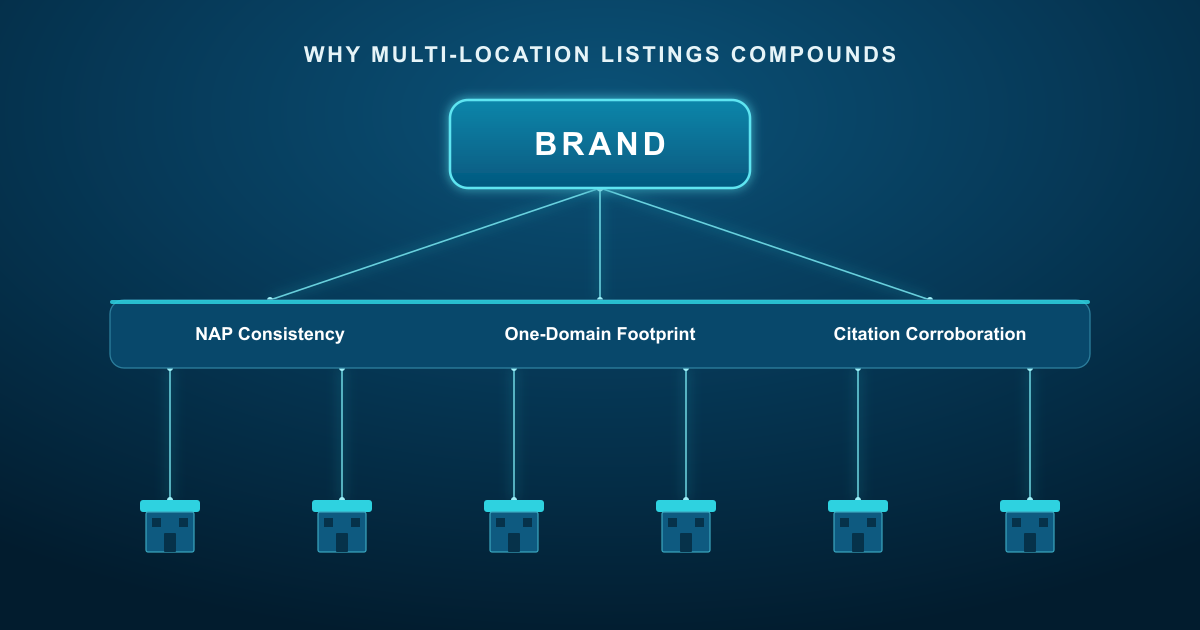
Search engines, and Google in particular, use the consistency of your business information across the web as a trust signal. When your NAP data matches across your Google Business Profile, your website, and dozens of third-party directories, it sends a clear signal that your information is reliable. When it doesn't match, Google faces uncertainty about which data is correct and tends to deprioritize listings it can't verify with confidence.
This is why citation consistency is a foundational element of any serious multi-location SEO strategy. It's not glamorous work, but the impact on local search rankings is real and measurable. Businesses that clean up citation inconsistencies often see meaningful ranking improvements in local map pack results within weeks, not months.
The consequences of inaccurate listings extend beyond SEO too. A wrong phone number means a missed call. An outdated address means a customer driving to the wrong location. Incorrect hours means someone showing up when you're closed. Each of these is a small failure that individually seems minor but collectively shapes how customers perceive your brand's reliability before they've even walked through the door.
What Is Local Listing Management Software?
Local listing management software is a platform that centralizes the process of updating, monitoring, and maintaining your business listings across multiple directories from a single interface. Rather than logging into Google, Yelp, Apple Maps, and every other directory separately to make updates, a listing management platform pushes changes across all connected directories simultaneously.
For multi-location businesses, this capability is not a convenience. It's a necessity. The question isn't whether you need a platform to manage listings at scale, it's what that platform needs to be able to do to actually solve the problem rather than just partially automate it.
What to Look For in Local Listing Management Software
Not all listing management platforms are built equally, and the differences matter considerably more as your location count grows. Here's what to evaluate when you're comparing options.
A Truly Centralized Dashboard
The value of a centralized dashboard isn't just convenience. It's visibility. When every location's listing data lives in one place, your marketing team can see at a glance which locations have complete profiles, which have inaccuracies, and where inconsistencies exist across platforms. Without that visibility, you're managing in the dark and reacting to problems rather than preventing them.
For businesses managing listings for dozens or hundreds of locations, the quality of the dashboard matters enormously. You need to be able to drill down to an individual location quickly, filter by region or market, and identify systemic issues across your entire footprint without having to manually check each listing one by one. A platform that makes this genuinely easy to do is worth paying for.
Automatic Syncing Across Directories
The core functionality of any listing management platform is the ability to push a single update across all connected directories automatically. When your hours change for the holidays, when a location moves to a new address, or when a phone number changes, that update needs to flow to every platform immediately and accurately. Manual updates at scale are not just slow. They're error-prone, and a partially updated listing is often worse than no update at all because it creates conflicting information across the web.
The depth of a platform's directory network matters here too. A platform connected to thirty directories serves you differently than one connected to three hundred. When evaluating options, ask specifically which data aggregators the platform syncs with, since aggregators are what push your information to the long tail of directories your team would never manually reach.
NAP Data Accuracy Monitoring
Syncing updates is one thing. Monitoring for unauthorized or incorrect changes that appear after the fact is another. Third-party directories sometimes overwrite your data with information pulled from other sources, and this can happen without any action on your part. A strong listing management platform monitors your NAP data continuously and alerts you when something changes unexpectedly, so inaccuracies are caught and corrected before they have time to propagate.
This is especially important for multi-location businesses where a data issue at one location can affect your brand's overall credibility in that market. The businesses asking which listing management platform offers the best accuracy for NAP data are asking exactly the right question, because not all platforms monitor with the same level of rigor.
Review Management Integration
Reviews are part of your listing whether you're actively managing them or not. Platforms that integrate review monitoring and response into the same interface as your listing management remove a significant operational friction point, particularly for multi-location businesses where review volume across locations can be substantial.
Beyond efficiency, there's an SEO dimension here too. Review recency and response rate are local ranking factors, and a platform that makes it easy for your team to respond to reviews promptly across all locations helps you maintain the kind of active listing presence that Google rewards. If you want to understand how review management fits into the broader picture of your brand's online reputation, Why Social Media and Reputation Management Belong Together covers the connection in more detail.
Local SEO Reporting by Location
You can't improve what you can't measure, and for multi-location businesses, brand-level reporting isn't enough. You need to see how individual locations are performing in local search, which listings are complete versus incomplete, and where gaps in coverage exist across your directory footprint.
The most useful listing management platforms surface this data at the location level and make it actionable. Which locations are missing photos? Which have outdated categories? Which markets have the weakest citation consistency? These are the questions that drive real improvement, and a platform that can answer them at scale gives your marketing team a meaningful advantage over competitors who are flying blind.
This kind of reporting also ties directly into broader marketing analytics strategy, where the connection between listing health and local search performance becomes a trackable, improvable metric rather than an assumption.
Scalability Without Proportional Effort
This is the criterion that matters most for growing businesses and often gets the least attention in software evaluations. The right platform should not require your team to do significantly more work as your location count grows. If adding twenty new locations to your footprint means twenty times more manual setup and maintenance work, the platform is not actually solving the problem at scale.
Ask vendors directly how businesses with large location counts manage bulk updates, how new locations get onboarded into the platform, and what the process looks like when a location closes or changes its information. The answers will tell you whether the platform was genuinely designed for multi-location businesses or whether it was built for single-location use and stretched to accommodate larger organizations.
When Manual Management Stops Working
For businesses with a handful of locations, manual listing management is possible, even if it's inefficient. The breaking point varies, but most marketing teams find that somewhere between five and fifteen locations, the time cost of manual updates and monitoring starts to crowd out higher-value work.
The more telling signal is often not location count but update frequency. A business in a seasonal industry that changes hours regularly across dozens of locations will hit the breaking point faster than a business with stable hours across the same number of locations. Similarly, a business operating in highly competitive local markets where listing accuracy directly drives call volume will feel the cost of poor management faster than one where organic traffic is less critical.
If your team is spending more than a few hours a week on listing updates, corrections, and review responses, or if you've discovered inaccurate information on your listings that you didn't know about, those are clear signals that manual management has already exceeded its capacity for your business.
Multi-Location Listing Management: What's Different
The challenges of listing management for a business with multiple locations are not simply a scaled-up version of single-location challenges. They're qualitatively different in several ways that matter when you're evaluating software.
At scale, consistency across locations becomes as important as accuracy within individual locations. Your brand name needs to appear identically across every location's listings. Your categories need to be consistent. The way you describe your services needs to align with your overall positioning while still reflecting legitimate local differences. A platform that gives you control over which fields are locked at the brand level and which can be customized at the location level is significantly more useful for this kind of management than one that treats all fields equally.
The brand-to-dealer or franchisor-to-franchisee dynamic adds another layer of complexity. If your business model involves independently operated locations under a shared brand, listing management becomes a governance challenge as much as a technical one. Who has permission to update which fields? How do you ensure a franchisee doesn't inadvertently change information that affects the brand's overall local search presence? These are questions worth asking before you commit to a platform, not after. As we cover in our multi-location lead generation guide, the gap between national brand visibility and local execution is where multi-location businesses most often lose customers, and listing management is a central part of closing that gap.
Listing Management and Local SEO Work Together
Local listing management and local SEO are not separate disciplines. They're deeply interconnected, and a weakness in one directly undermines the other. Consistent, complete, and actively managed listings are a prerequisite for strong local SEO performance, and strong local SEO is what turns listing visibility into actual customer contact.
The businesses that rank consistently well in local map pack results across multiple markets share a common characteristic: their listing management infrastructure is solid. Their NAP data is consistent. Their profiles are complete. Their reviews are recent and responded to. Their categories are accurate. These aren't the most visible or exciting parts of a local marketing strategy, but they are the foundation everything else is built on.
If you're evaluating your local SEO strategy more broadly alongside listing management, our complete multi-location SEO guide covers how listing management fits into the full picture of ranking across multiple markets.
What PowerChord Does Differently
PowerChord's local listing management is built specifically for multi-location businesses and the brand-to-dealer networks that serve them. Rather than adapting a single-location tool to fit a more complex use case, PowerStack is designed from the ground up for the operational reality of managing listings across dozens or hundreds of locations simultaneously.
That means a centralized dashboard with location-level visibility, automatic syncing across 60+ directories, continuous NAP accuracy monitoring, and integrated review management, all in one place. The platform scales without creating proportional work for your team, so adding locations to your footprint does not mean adding hours to your workload.
If you are ready to take the guesswork out of listing management, see everything included in our Listings Management module or get in touch and our team will walk you through what it looks like for your specific business.
Frequently Asked Questions
What is local listing management software?
Local listing management software is a platform that allows businesses to update, monitor, and maintain their information across multiple online directories from a single interface. Rather than logging into each directory separately, a listing management platform pushes changes simultaneously across all connected platforms, ensuring that your business name, address, phone number, hours, and other information remains accurate and consistent everywhere your locations appear online.
Why does NAP consistency matter for local SEO?
Search engines use the consistency of your business name, address, and phone number across the web as a trust signal. When your NAP data matches across Google Business Profile, your website, and third-party directories, Google gains confidence that your information is reliable and is more likely to surface your listing in local search results. Inconsistencies create uncertainty that search engines resolve by deprioritizing the conflicting listings.
When should a business invest in listing management software?
Most businesses benefit from a dedicated listing management platform once they operate more than five to ten locations, or whenever manual updates and monitoring are consuming more than a few hours per week. The more frequently your business information changes, the sooner a purpose-built platform pays for itself in time savings alone, before factoring in the SEO and customer experience benefits.
What is the best listing management software for multi-location businesses?
The best platform for multi-location businesses is one built specifically for that use case rather than adapted from a single-location tool. Key capabilities to look for include a centralized dashboard with location-level visibility, broad directory network coverage including major data aggregators, continuous NAP accuracy monitoring, integrated review management, granular permission controls for brand versus location-level fields, and scalability that does not create proportional manual work as your location count grows.
How does listing management connect to local SEO performance?
Listing management and local SEO are directly connected. Consistent, complete, and actively managed listings are one of the foundational signals Google uses to rank businesses in local map pack results. Businesses with strong listing management infrastructure consistently outperform competitors with thin or inconsistent listings in local search, which translates directly into more calls, more website visits, and more in-store traffic from customers who found them through organic local search.
Can listing management software handle franchise and dealer networks?
Yes, but not all platforms handle this equally well. The key capability to look for is granular permission controls that allow brand-level fields to be locked while giving local operators the flexibility to customize information specific to their location. This prevents franchisees or dealers from inadvertently changing brand-critical information while still allowing the local customization that helps individual locations rank well in their specific markets.
What are the benefits of using business listing management software?
The primary benefit is accuracy at scale. A business managing ten or more locations cannot realistically keep every directory current through manual updates without dedicating significant staff time to the task and still making errors. Listing management software eliminates that burden by pushing updates across all connected directories simultaneously, so when hours change or a location moves, every platform reflects the correct information within hours rather than weeks. The downstream benefits follow from that accuracy. Consistent NAP data across the web improves local search rankings because search engines surface listings they can verify with confidence. Customers who find accurate hours, addresses, and phone numbers convert at higher rates than those who encounter conflicting information and lose trust before ever making contact. And for multi-location businesses, the reporting visibility that comes with a centralized platform makes it possible to see which locations have listing gaps or inconsistencies before those gaps cost leads.
How do I fix inaccurate business listings across multiple directories?
The first step is identifying where the inaccuracies exist, which requires either a manual audit of each major directory or a platform that scans your listing data across the web and surfaces inconsistencies in one view. Once you know what is wrong and where, you have two options. You can correct each listing individually by claiming and updating your profiles on each platform, which is feasible for a small number of locations and directories but becomes unmanageable at scale. Or you can use a listing management platform that pushes correct data across all connected directories simultaneously and monitors for unauthorized changes afterward. The second approach is the only one that holds at scale, because directories sometimes overwrite your corrected data with information pulled from other sources, and without continuous monitoring those corrections degrade over time.
What directories should my business be listed on?
Every local business should have a fully claimed and completed profile on Google Business Profile, Apple Maps, Bing Places, Yelp, and Facebook at minimum, since these are the platforms that drive the most direct consumer traffic. Beyond those, the data aggregators, specifically Neustar Localeze and Foursquare, are critical because they push your business information to hundreds of downstream directories you would never manually reach. Industry-specific directories matter too depending on your category: Angi and HomeAdvisor for home services companies, Healthgrades and Zocdoc for medical practices, TripAdvisor for hospitality. For multi-location businesses, the priority is ensuring that every location has a complete, accurate, and actively managed presence on the high-traffic platforms first, then using a listing management platform to extend that accuracy across the long tail of directories automatically.
How long does it take to fix listing inconsistencies?
The timeline depends on how widespread the inconsistencies are and whether you are correcting them manually or through a listing management platform. Manual corrections on the major platforms, Google, Apple Maps, Bing, Yelp, take effect within a few days to a couple of weeks depending on each platform's review process. Data aggregator updates, which push to the broader directory ecosystem, typically take four to eight weeks to propagate fully across downstream platforms. With a listing management platform that syncs directly with major directories and aggregators simultaneously, the correction process is significantly faster and more comprehensive than manual updates. Businesses that clean up citation inconsistencies through a centralized platform consistently see measurable improvement in local search rankings within six to eight weeks of the corrections taking effect.