.svg "PowerChord-Logo")

How to Evaluate Franchise Marketing Software, Agencies, Local Store Marketing, and Multi-Location Platforms
Every franchisor eventually runs into the same wall. The brand is established, the system is sold, the franchise agreement requires local marketing, and the national ad fund is collecting its two percent. Then you look at the network and find that franchisee 43 in Tulsa has not touched their Google Business Profile in four months, three locations in the Southeast have not responded to a negative review since spring, half the system never claimed their co-op match before it expired, and nobody at headquarters knew about any of it until a franchisee called to ask why their location is not getting leads.
The instinct is to buy a platform. That is the right instinct, and it is also where most franchisors lose a year. The franchise marketing technology category is crowded with tools that solve a piece of the problem, and almost all of them share one assumption that does not survive contact with a real franchise network: that somebody at the location will use them.
PowerChord serves franchise systems, multi-location brands, and dealer networks across fitness, home services, HVAC, roofing, restaurants, medical and dental, banking, and equipment categories. What follows is the vendor landscape as it actually exists, the three layers these platforms operate in, what we find when we look at adoption inside real networks, and the questions worth asking before you sign anything.
The franchise marketing platform landscape
Franchisors evaluating platforms encounter five categories of vendor. Understanding what each category solves, and what it leaves on the franchisee's desk, is the most important step in choosing correctly.
Brand portals and template systems give franchisees a library of brand-approved assets they can localize themselves. Papirfly, Marq, Marvia, and CampaignDrive operate here, providing digital asset management, lockable templates, and approval workflows so a franchisee can produce a flyer or a social graphic without breaking brand standards. These systems solve brand consistency well. What they do not do is produce the marketing. The franchisee still logs in, picks a template, customizes it, and publishes it, which means output depends entirely on franchisee willingness and skill.
Franchise operations platforms manage the franchise relationship itself. FranConnect is the established name here, covering franchise development, onboarding, field operations, compliance audits, and franchisee performance tracking, with marketing modules inside a broader operations suite. This is valuable infrastructure. Franchise management software is operations software. It runs the franchise system. It is not built to run local marketing in eighty markets.
Local visibility software covers listings, reviews, and social publishing across many locations. SOCi, Yext, Uberall, and Birdeye compete here, each with a center of gravity. Yext and Uberall are strongest on location data and listings syndication. Birdeye is strongest on review generation and customer messaging. SOCi spans social publishing, reputation, and listings with a multi-location orientation. These platforms are good at what they do, and they are software: they give a brand the ability to manage listings and reviews at scale, which is different from someone actually doing it.
Co-op and marketing fund administration handles the money. BrandMuscle and Ansira, which consolidated SproutLoud and Brandmuscle through acquisition, are the enterprise names, built for brands distributing co-op and market development funds across large partner networks with compliance documentation and reimbursement workflows. Their strength is fund governance at scale for brands with substantial internal channel marketing teams. Execution across locations is not part of the platform relationship.
Platform with managed execution is the fifth category, and the one with the fewest occupants. PowerChord operates here as a Software with a Service company. PowerStack covers the local marketing infrastructure for every location, and PowerPartner is a managed services team that works as an extension of the franchisor's marketing department, carrying the brand's program into every individual market rather than leaving execution to franchisees who are not marketers or to a corporate team of three or five that cannot cover a hundred locations. The distinction is not a feature comparison. It is a different answer to the question of who does the work. The same model applies to manufacturer dealer networks, which we cover in our guide to dealer network marketing platforms.
The three layers of franchise marketing
The most useful thing a franchisor can do before evaluating vendors is recognize that franchise marketing technology operates in three distinct layers, and that most platforms occupy exactly one.
The enablement layer gives franchisees the ability to market. Templates, brand portals, asset libraries, approval workflows, and campaign calendars all live here. The output of this layer is capability. A franchisee who wants to run a local campaign can now do it on brand.
The visibility layer manages how each location appears in the places customers look. Listings accuracy across directories, Google Business Profile management, review generation and response, social publishing, and local search presence live here. The output of this layer is presence, provided someone operates the software.
The execution layer is where the work actually happens. Campaigns get built and optimized, listings get corrected when they drift, reviews get responded to, content gets written, social gets posted, paid budgets get shifted toward what is converting, and AI search visibility gets built and maintained. The output of this layer is results.
Mapped against the vendor landscape, brand portals occupy the enablement layer, listings and reputation software the visibility layer, and almost nothing in the category occupies the execution layer.
Here is the structural problem in franchising. The first two layers hand someone a tool. Somebody still has to pick it up and use it, week after week.
With the enablement layer, that somebody is the franchisee, and franchisees are not marketers. They bought a business. They are managing staff, inventory, customers, and payroll, and a login to a template library does not create the hours or the expertise to use it. With the visibility layer, it is usually the corporate marketing team, which sounds better until you count the math. A team of three or five people operating listings, reviews, and social software across a hundred markets is not going to keep every market current, no matter how good the software is.
Either way you have bought capability rather than results, and the gap between the two is however much time and skill the person holding the tool actually has.
That is the theory. What follows is what we actually measure.
The adoption problem nobody quotes a number for
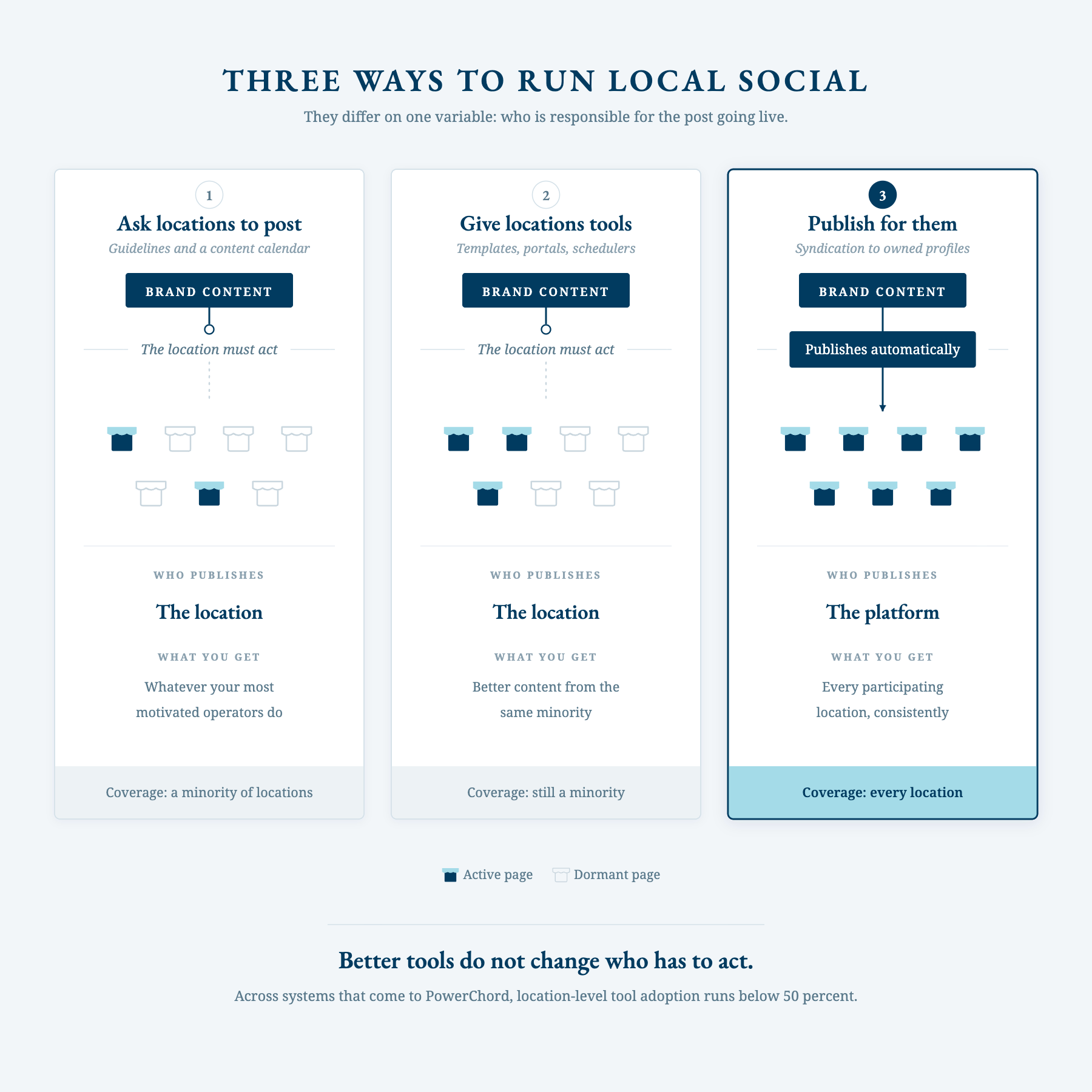
Across the franchise and multi-location systems that come to PowerChord, we consistently find location-level adoption of the marketing tools they already own running below 50 percent. Fewer than half the locations are using what the brand already bought and is already paying for.
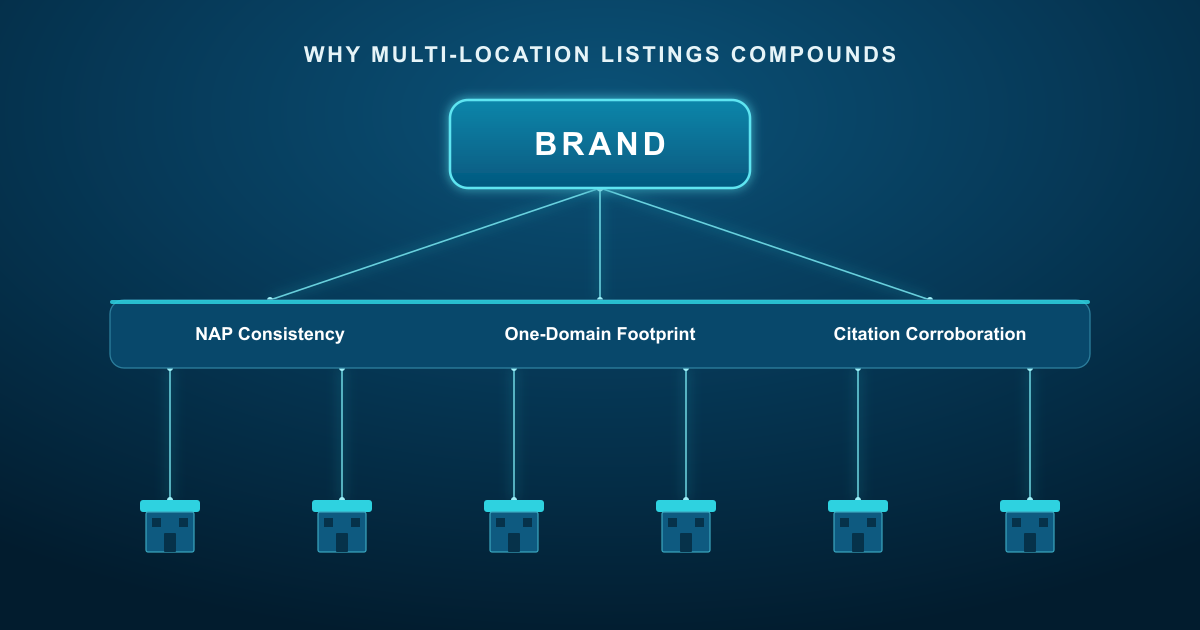
That figure comes from the systems that approach us, which are brands already aware something is not working, so it is not a claim about franchising as a whole. But it is a remarkably consistent pattern, and it changes what you should be evaluating in the first place. A brand with adoption below half is not capturing half the value of its platform. It is running an inconsistent brand: most markets with drifting listings, stale social profiles, unanswered reviews, and unclaimed co-op, alongside a minority that look great. Inconsistency at scale is worse than a uniformly modest program, because the weak locations drag on the brand's overall entity signals and the strong ones cannot compensate, which is the compounding effect we cover in multi-location listings management.
It also explains something every franchisor has seen. The locations with the lowest tool adoption are almost always the locations with the weakest performance, which are the locations most likely to blame corporate marketing for not producing leads, which produces friction in exactly the relationships that are hardest to repair. The adoption gap is not just a software utilization problem. It is a franchisee relations problem.
This is the reason PowerChord is built the way it is. PowerPartner exists because handing a franchisee a login does not produce local marketing, and because the honest read on adoption is that it never will at the rates a brand needs. The team operates the tools on behalf of every location so coverage does not depend on individual franchisee engagement, and where a franchisee does want to participate, the team works with them to get full use of what they have rather than leaving them to figure it out. The measure that matters is not how many locations logged in. It is how many locations have accurate listings, active social, managed reviews, running campaigns, and leads arriving, and that number should be all of them.
That sometimes lands wrong, because franchisors hear it as an offer to take over. PowerPartner is an extension of the franchisor's marketing department, not a replacement for it. Corporate still owns the brand, the strategy, the calendar, and the standards. What the team adds is the capacity to carry that strategy into every individual market, which is the part no corporate marketing department is staffed to do across a hundred locations and no franchisee is equipped to do alone. The team is the bridge between the two. Corporate gets its program actually executed in the field rather than distributed and hoped for, and each franchisee gets a functioning local marketing operation they did not have to build or learn. Both sides of the franchise agreement come out ahead, which matters more than it sounds, because marketing is one of the most common sources of friction between a franchisor and its franchisees and most of that friction traces back to the gap between what corporate provides and what locations actually use.
Social is where the adoption gap shows first
Of everything a franchisor asks locations to do, social fails the most visibly. A location's Facebook page whose last post is from fourteen months ago is obvious to anyone who looks, and it is often the first thing a prospective customer checks to decide whether a business is still worth visiting.
It is also the request franchisees are least equipped to meet, because posting is not a setup task. It is a recurring content obligation, several times a week, indefinitely. A brand portal that gives a franchisee lockable templates has made that task easier without removing it. A scheduling tool has given them somewhere to do work they were never going to do. Both leave the same person with the same missing hours.
The alternative is to stop depending on the franchisee for the baseline, which is what SocialConnect does. The brand creates a post once at corporate, and SocialConnect publishes it to every opted-in location's own Facebook, Instagram, and Google Business Profile, filling in that location's real name, address, phone, and website so the post reads as local rather than as corporate content copied across the network. Each location connects its accounts a single time, and from then on the brand can guarantee that posts get made, on brand, in every market, whether or not any individual operator engages that week. This is social media syndication rather than social media management, and the distinction is who does the publishing.
That does not mean the franchisee stops posting. It means the network no longer depends on them to. Locations keep full access to their own accounts and are encouraged to post their own local content, because the posts only they can make are often the ones that perform best: the team, a community event, a customer hitting a milestone, the local sponsorship nobody at corporate knows about. They can see the calendar of scheduled brand posts inside PowerStack, so they plan around it rather than doubling up. Syndicated brand content becomes the floor rather than the ceiling. A location that never posts still has an active, professional, on-brand page. A location that does post is adding the local stuff to a feed that was already working.
Both sides of the franchise agreement gain something specific. The franchisor's content stops dying on the corporate page and reaches the audience following each individual location, which across a network is usually several times larger in aggregate than corporate's own following, and the message stays consistent because it was written once. The franchisee gets a page that stays active whether or not this was the week they had time, plus a head start on the local content they do want to publish. Nothing in the enablement or visibility layer does that, because both make the baseline itself conditional on the location acting.
How the vendor landscape breaks down for social specifically, and how the franchise and dealer structures differ in what content can even say, is covered in our guide to social media management for franchise and dealer networks.
Franchise marketing software versus franchise management software
These two phrases get used interchangeably and they describe different products. The confusion costs franchisors real evaluation time.
Franchise management software runs the franchise system. Franchise development and lead tracking for selling units, franchisee onboarding, operations manuals, field audits, compliance tracking, royalty reporting, and performance benchmarking across the network. FranConnect, Naranga, and similar platforms serve this need. If your problem is that franchise development is disorganized or field operations are inconsistent, this is your category.
Franchise marketing software runs local marketing across the locations. Listings, reviews, local search, paid media, social, email, lead capture and routing, call tracking, and reporting that connects spend to revenue at every location. If your problem is that customers in Dallas cannot find your Dallas location, or that your ad fund is not producing measurable leads, this is your category.
Most franchisors need both, and they are rarely the same vendor. Buying an operations platform and expecting it to solve local marketing is one of the more common and expensive category errors in franchising.
Franchise marketing platform, agency, or both
Most franchisors arrive at this decision framed as a choice between buying software and hiring an agency, and the two options fail in opposite directions.
A franchise marketing agency brings execution. Real people build the campaigns, write the content, fix the listings, and answer the reviews. What most agencies do not bring is the platform underneath: a system where corporate sees every location in one view, where leads route to the right franchisee automatically, where ad fund utilization is visible as it happens, and where each franchisee logs in to see their own numbers rather than waiting for a report. Without that layer the work happens in a black box, performance arrives as a monthly deck, and franchisees have no independent visibility into what is being done on their behalf, which is where most of the friction between corporate marketing and the field comes from.
Software solves the visibility problem and reintroduces the execution problem. The dashboards are good, and the work still has to be done by someone who is not there.
PowerChord is built as Software with a Service because franchise systems need both halves and buying them separately leaves a gap where the two are supposed to meet. PowerStack is the platform corporate and every franchisee log into. PowerPartner is the team working inside it. The reporting is not a deck assembled after the fact, it is the same live data the team is acting on, which means corporate, the franchisee, and the people doing the work are all looking at one set of numbers.
Seven criteria for evaluating a franchise marketing platform
Who does the work is the first criterion and the one that matters most, and it is the one most evaluations skip. Every vendor demo shows you a capable interface. The question to ask is what happens after signature: does your team configure and operate this, does each franchisee, or does the vendor's team run it across every location. Ask the vendor what adoption looks like in comparable networks, and ask what happens in the locations that never engage. For a franchisor whose corporate marketing staff is small relative to the network, and whose franchisees did not sign up to be marketers, a software-only platform will operate at a fraction of its capability. That one answer changes what the whole thing is actually worth.
Brand control with local permission is the second. The platform needs to let corporate lock brand standards, approved messaging, and logo usage while leaving the local details, hours, market-specific offers, community involvement, editable at the location. A platform that forces a choice between total central control, which produces irrelevant local marketing, and total local freedom, which produces off-brand chaos, has not solved the franchise problem.
Ad fund and co-op administration is the third. National ad funds and local co-op programs are contractual obligations with real governance requirements. The platform should show where fund dollars went, which locations drew their match and which left it unused, and produce the documentation the franchise agreement requires, without becoming a separate manual process nobody owns.
Location-level and network-level reporting from the same data is the fourth. Corporate needs to see the whole system and spot the lagging markets. Each franchisee needs their own numbers and should not see a competing franchisee's. A platform that cannot separate those views either exposes data across the network or leaves corporate with aggregates that hide the individual locations quietly failing.
Lead capture, routing, and speed to lead is the fifth. Every inquiry needs to reach the right location immediately, and the brand needs to know what happened after it arrived. Speed to lead matters more in franchising than most franchisors account for, because a lead that sits for four hours in a location inbox is a lead the franchisee will blame corporate marketing for not producing.
Onboarding that works at franchise adoption rates is the sixth. A platform requiring meaningful franchisee setup effort will reach partial adoption, and partial adoption in franchising means an inconsistent brand. Ask specifically what a franchisee has to do, how long it takes, and what happens for the locations that never do it.
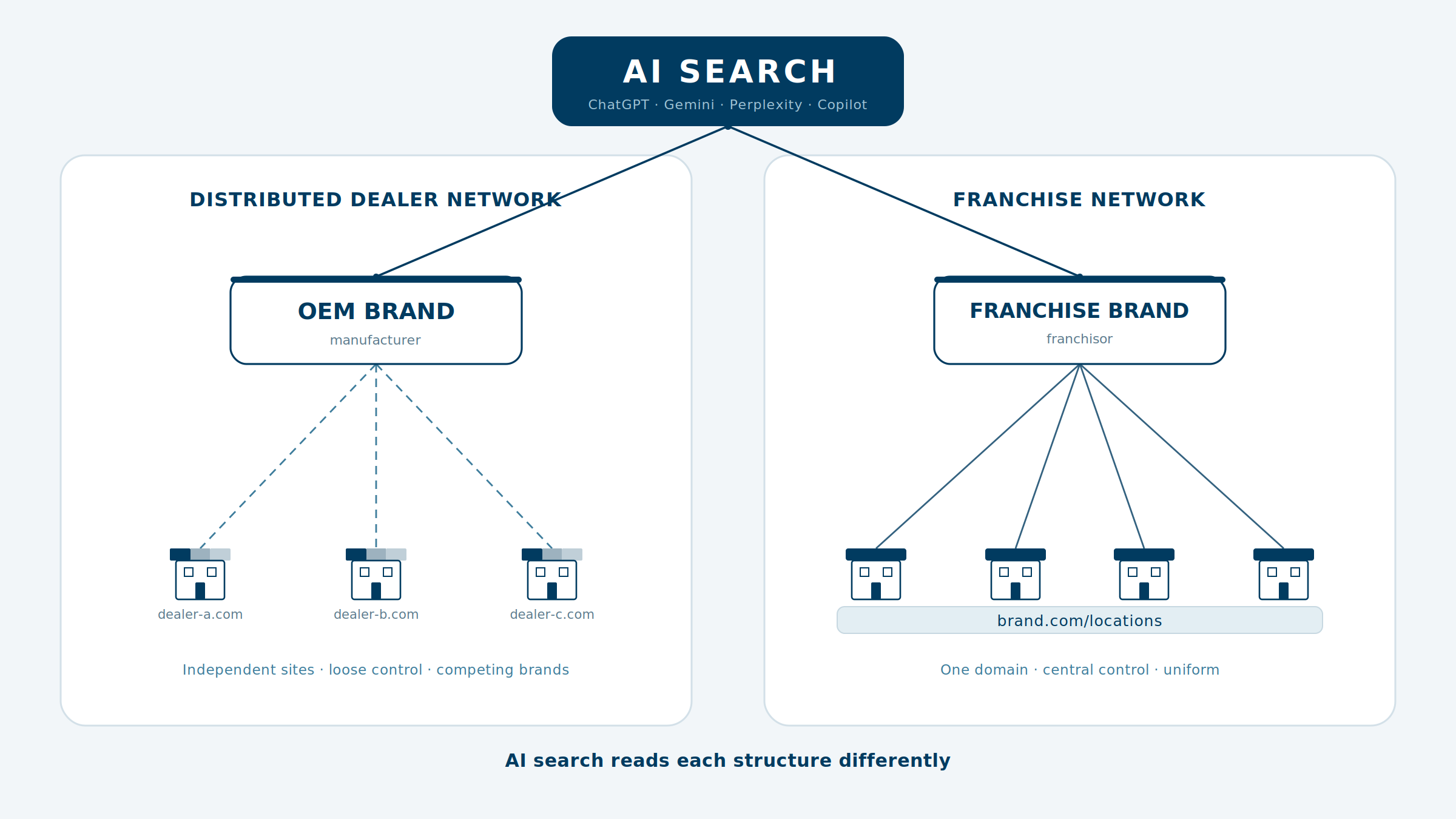
AI search visibility is the seventh and the most forward-looking. Customers increasingly ask ChatGPT, Perplexity, or Google's AI Overviews for a business in their area and get two or three names rather than ten links. Whether your locations appear in those answers is now a measurable thing, and almost nothing in this category tracks it. It also works differently for a franchise than for a dealer network, since AI evaluates each location as its own entity while the governance model differs by structure, which we cover in how AI search treats distributed and franchise networks differently. It is worth asking about directly, because the platforms that cannot measure it also cannot improve it. And it matters on two fronts in a franchise system rather than one, which the next section covers.
The two sides of franchise AI search visibility
Franchisors have a second AI search problem most vendors never raise, because it belongs to a different department.
A franchise system markets to two entirely different audiences. The consumer side is what everyone means by local marketing: a customer in Charlotte asking for a gym, a homeowner in Dallas asking for a roofer, someone in Tampa looking for a place to get their oil changed. The franchise development side is the other: a prospective franchisee researching which brands to invest in, asking what a franchise costs, which concepts are growing, and which system would work in their market.
Both now happen in AI tools, and they are separate optimization problems with separate competitors and separate winning content.
On the consumer side, the competition is other local businesses market by market, and the unit of optimization is the location. Every location has to be a legible, well-corroborated entity in its own right, because AI evaluates them individually rather than crediting the brand.
On the franchise development side, the competition is other franchise concepts and the portals that aggregate them, Franchise Direct, Entrepreneur's Franchise 500, FranNet, and similar directories that currently dominate those answers. The unit of optimization is the brand, and the content that wins is what an investor actually asks for: total investment, available territories, unit economics, and what support the franchisor provides.
Here is where the two connect. Consumer-side AI visibility has become franchise development ammunition.
A prospective franchisee is evaluating one thing above all others: whether this brand will actually generate customers for them. Historically that got answered with brand awareness claims and national ad fund figures. Now there is a more direct answer. A franchisor that can show a prospect that its locations are being named when customers ask ChatGPT or Google's AI Overviews for a business in their category, market by market, is demonstrating demand generation in the channel where discovery is moving. A franchisor that cannot show that, or has never measured it, is asking the prospect to take brand strength on faith.
That makes AI search visibility unusual among marketing investments in a franchise system. It serves existing franchisees by driving customers to their locations, and it serves franchise development by giving the sales team evidence the brand produces local demand. Very little marketing spend does both.
To be clear about scope, PowerChord's AI search visibility work covers both sides. On the consumer side that means building the entity foundation for every location and tracking which ones get named, market by market and engine by engine. On the franchise development side it means the same discipline applied to brand-level recruitment prompts, the questions a prospective franchisee asks when researching which concepts to invest in, tracked as their own prompt set so the franchise development team can see whether the brand surfaces and where it does not. What sits outside that is the rest of franchise development: broker networks, paid portal placements, the FDD and legal process, discovery day, and franchise sales CRM. PowerChord does the visibility work that determines whether a brand appears in the answer at all. Converting that interest into a signed agreement is the development team's job.
Everything PowerChord runs for a franchise network
PowerStack is the platform layer, built for the brand-to-local structure rather than adapted to it.
Listings Management keeps every location accurate across 60-plus directories including Google, Bing, Apple Maps, and Yelp, syncing from one source so a change propagates everywhere instead of being chased directory by directory. Reputation Management monitors and responds to reviews at every location and automates review requests after customer interactions. SocialConnect distributes brand-approved social content to every location's own profiles, personalized per market, covered in detail above. Microsites and Lead Management gives every location a co-branded local page built to convert in its own market, with every lead routed to the right location and visible to corporate in real time. Call Tracking connects every inbound call to the campaign that produced it, with recording, transcription, and AI-generated summaries. CRM tracks every lead from first touch through closed revenue with multi-location segmentation.
Reporting is where the consolidation actually pays off. Most multi-location brands are reading performance out of four or five separate places: one report for listings, another for reviews, another for social engagement, another for paid media, another for the website. Nobody reconciles them, so nobody can answer what the program produced. PowerStack reports every channel into one dashboard, fully customizable to what each audience needs to see, so corporate gets a network-wide view of the entire program in one place and each franchisee gets their own location's numbers in the same system. One login, one set of numbers, no reconciliation.
PowerPartner is the execution layer, working as an extension of the franchisor's marketing team rather than a replacement for it, and it is what separates this from the rest of the category.
Paid Media Management runs geo-targeted campaigns in every location's market, including Google Ads, Local Services Ads, paid social, display, retargeting, and connected TV, with budgets shifted continuously toward what is converting. Local SEO builds organic visibility for each location independently rather than for the brand generically. AI Search Visibility is a managed practice, building the entity foundation that makes each location legible to AI systems and reporting across ChatGPT, Perplexity, Google Gemini, Microsoft Copilot, Claude, and Poe so you can see which locations are being named and act on the ones that are not. Social Media Management creates and runs the social program when a brand wants the content produced for them, pairing naturally with SocialConnect for distribution. Email Marketing re-engages past customers at every location. Revenue Operations connects marketing spend to closed revenue across the system so the ad fund can be defended with numbers.
Co-op and ad fund programs are managed inside the platform, so fund utilization is visible in real time and unspent balances get flagged before they expire rather than after. And the whole program runs across every location simultaneously, which is the point: a franchisee's local presence does not depend on that franchisee's interest in marketing.
What this looks like in a franchise system
PowerChord works with RockBox Fitness, a boutique fitness franchise, across both sides of the problem this guide describes.
On the consumer side, that means location-level entity work across the system: structured data built for every studio, listings and rating accuracy maintained per location, and AI search visibility tracked so the brand can see which studios are named when someone asks an AI tool for a gym or a kickboxing class in their market, and which have dropped out of the answer. Where a location is missing, the team closes the gap rather than reporting it.
On the franchise development side, brand-level recruitment prompts are tracked as their own set, so the franchise development team can see whether RockBox surfaces when a prospective franchisee researches fitness concepts to invest in, separately from how individual studios perform with consumers.
That two-sided structure is what most franchise systems are missing. Results across PowerChord's other multi-location and dealer networks are covered on the case studies page.
Choosing for your system
If your franchisees are actively engaged in marketing and just need brand-compliant assets, a brand portal may be sufficient. If your problem is franchise development and field operations, you need franchise management software, and marketing is a separate purchase. If you have internal marketing capacity to operate software across every location, the visibility platforms are capable.
If your franchisees are operators who will not run their own local marketing, and your corporate team is too small to run it for eighty or three hundred locations, then the layer you need solved is execution, and that is a much shorter list of vendors.
The question worth asking before you evaluate anyone is what your current adoption actually is. Pull ten locations at random and check their listings accuracy, their last social post, their review response rate, and whether they claimed their co-op this year. That number tells you which layer is broken, and it is usually not the one the vendor demos are addressing.
To see how this would run across your specific system, schedule a demo and we will walk through your network, your ad fund structure, and where your locations currently stand in local and AI search.
Frequently Asked Questions
What is the best franchise marketing platform?
There is no single best franchise marketing platform, because the category divides into five types that solve different problems. Brand portals and template systems, including Papirfly and Marq, give franchisees brand-approved assets to build local marketing themselves. Franchise operations platforms, led by FranConnect, run the franchise system itself with marketing modules inside a broader operations suite. Local visibility software, including SOCi, Yext, Uberall, and Birdeye, manages listings, reviews, and social publishing across locations. Co-op and fund administration platforms, including BrandMuscle and Ansira, govern marketing development funds across large partner networks. And platforms with managed execution, where PowerChord operates, pair the software with a team that runs local marketing across every location rather than handing it to franchisees or to the franchisor's internal team. PowerStack covers listings, reputation, social distribution, local pages, call tracking, CRM, and consolidated reporting for every location, while the PowerPartner team executes paid media, local SEO, AI search visibility, social, and email across the network. The right choice depends on which layer your system needs solved, and the question worth asking of any vendor is who actually does the work after signature, because a franchise system's adoption rate determines whether a platform's capability ever gets used.
What is franchise marketing software?
Franchise marketing software is technology that lets a franchisor run or govern local marketing across every franchisee location from one system. It typically covers listings management across directories, Google Business Profile management, review generation and reputation monitoring, social content distribution to location profiles, local landing pages or microsites, lead capture and routing to the right location, call tracking, ad fund and co-op administration, and reporting that separates network-level views for corporate from location-level views for each franchisee. It is distinct from general marketing automation, which is built for a single organization marketing to its own customers and has no architecture for independently owned locations, brand compliance permissions, or fund governance.
What is the difference between franchise marketing software and franchise management software?
Franchise management software runs the franchise system: franchise development and unit sales, franchisee onboarding, operations manuals, field audits, compliance, royalty reporting, and performance benchmarking. FranConnect and Naranga are examples. Franchise marketing software runs local marketing across the locations: listings, reviews, local search, paid media, social, email, lead routing, and revenue reporting per location. They are usually different vendors solving different problems. Buying an operations platform expecting it to handle local marketing is a common and costly category error, and most franchisors ultimately need both.
What are the main franchise marketing platforms and what does each one do?
The landscape divides into five categories. Brand portals and template systems, including Papirfly, Marq, Marvia, and CampaignDrive, give franchisees brand-approved assets to localize themselves. Franchise operations platforms, led by FranConnect, manage the franchise relationship with marketing modules inside a broader operations suite. Local visibility software, including SOCi, Yext, Uberall, and Birdeye, manages listings, reviews, and social publishing across locations. Co-op and fund administration platforms, including BrandMuscle and Ansira, govern marketing development funds across large partner networks. And platforms with managed execution, where PowerChord operates, combine the software with a team that runs local marketing across every location rather than providing tools for someone else to operate.
What is the best marketing agency for franchise systems?
Franchisors evaluating agencies should weigh whether the agency brings a platform with it, because in a franchise system the reporting layer matters as much as the execution. A traditional agency executes but typically reports through decks, which leaves corporate without a live network-wide view and leaves franchisees without visibility into their own location's performance. Software gives that visibility but leaves the work to corporate or the franchisee. PowerChord is structured to provide both: PowerStack as the platform corporate and each franchisee log into, and the PowerPartner team running paid media, local SEO, AI search visibility, social, email, and reputation management across every location inside it. For franchise systems, the practical question is less agency versus platform and more whether one relationship covers execution and visibility together, or whether you are managing two vendors and reconciling their numbers.
How do franchisors handle local marketing when franchisees do not have time for it?
This is the central problem in franchise marketing, and it is not solved by giving franchisees better tools. A franchisee is an owner-operator managing staff, customers, and payroll, not a marketer, so capability handed to them rarely converts into activity. The approaches that work remove the dependency on the franchisee rather than making their task easier. Social content is distributed to their profiles automatically rather than requiring them to post. Listings are maintained centrally rather than by each location. Reviews are monitored and responded to by a team. Paid campaigns are built and optimized centrally and geo-targeted per market. Leads route to the location automatically with immediate first contact. The franchisee's only job becomes serving the customer that arrives, which is the job they signed up for.
How do franchise brands keep every location's social media active?
Social is the most visible adoption failure in a franchise system, because a location page whose last post is over a year old is obvious to any customer checking whether the business is worth visiting. It is also the hardest thing to delegate to a franchisee, since posting is a recurring content obligation several times a week rather than a one-time setup task. Templates and scheduling tools make that work easier without removing it, so the same operator with no spare hours is still the bottleneck. The approach that produces consistent coverage stops depending on the franchisee for the baseline: the brand creates a post once at corporate and it publishes automatically to every location's own Facebook, Instagram, and Google Business Profile, personalized with that location's real name, address, and phone so it reads as local rather than as corporate content copied across the network. This is social media syndication rather than social media management. PowerChord's SocialConnect works this way, with each location connecting its accounts a single time, which means the brand can guarantee posts get made everywhere while locations keep their own accounts and are encouraged to add local content on top. Brand syndication becomes the floor rather than the ceiling, so a location that never posts still has an active page and a location that does is building on one that was already working.
What is a typical franchisee adoption rate for marketing tools?
Lower than most franchisors expect. Across the franchise and multi-location systems that come to PowerChord, we consistently find location-level adoption of existing marketing tools running below 50 percent, meaning fewer than half the locations are actively using what the brand already bought for them. That sample is self-selected, since these are brands already looking for help, but the pattern is consistent enough to plan around. The practical consequence is not that the brand captures half the value. It is that the brand becomes inconsistent, with a minority of markets well managed and most drifting, and inconsistency across a network undermines the brand's local presence more than a uniformly modest program would. Any platform evaluation should include a direct question about what happens in the locations that never engage, because that is where most of the network usually ends up.
Does a franchise marketing partner replace the franchisor's internal marketing team?
It should not, and a franchisor evaluating vendors should be clear about which model they are buying. Corporate marketing owns the brand, the strategy, the campaign calendar, and the standards, and those should stay in house because nobody outside the system knows the brand better. What most corporate marketing departments lack is the capacity to carry that strategy into every individual market, since a team of three or five cannot personally manage local search, listings, reviews, social, and paid media across a hundred locations. That is the gap a managed partner fills. PowerChord's PowerPartner team works as an extension of the franchisor's department, executing the brand's program at the location level and reporting into the same platform corporate and franchisees both use, so the brand keeps ownership of strategy while gaining the execution capacity to make it real in every market. The franchisee benefits from the same arrangement, getting a working local marketing program without having to become a marketer.
What should a franchisor look for in a franchise marketing platform?
Seven criteria matter most. First, who actually does the work, whether corporate, the franchisee, or the vendor's team, because this determines whether the platform's capability ever gets used. Second, brand control with local permission, so corporate locks standards while locations customize the local details. Third, ad fund and co-op administration with real visibility into utilization and the documentation the franchise agreement requires. Fourth, reporting that serves both the network view for corporate and the location view for each franchisee from the same data. Fifth, lead capture, routing, and speed to lead so inquiries reach the right location immediately. Sixth, onboarding light enough to reach full adoption rather than partial. Seventh, AI search visibility tracking, since a growing share of local discovery now happens in AI-generated answers and most platforms in this category cannot measure it.
How do franchise marketing platforms handle brand compliance across franchisees?
The workable model is central control of brand elements with local permission for market-specific details. Corporate locks logo usage, approved messaging, campaign creative, and required disclosures, while each location can manage hours, contact information, local offers, and community content within those parameters. Brand portal platforms implement this through lockable templates and approval workflows. Platforms with a managed execution layer handle it differently: because the content is produced centrally and distributed to locations rather than created by franchisees, brand compliance is a property of how the system works rather than a rule that has to be enforced. PowerChord's SocialConnect, for example, publishes brand-approved posts to every location's own profiles personalized with that location's details, so the output is on brand and locally relevant without a franchisee needing to follow guidelines.
How do franchise marketing platforms manage the national ad fund and local co-op?
Ad fund and co-op administration should live inside the platform rather than as a parallel spreadsheet process. That means visibility into how national fund dollars were deployed by market, which locations drew their local co-op match and which left it unclaimed, what the money produced in leads and revenue per location, and documentation sufficient for the reporting the franchise agreement requires. The failure mode is common and expensive: funds expire unused because the claim process is too complicated for franchisees to navigate, and corporate cannot demonstrate what the fund produced when franchisees question it. A platform that surfaces utilization in real time and flags unspent balances before expiration turns the fund from a compliance obligation into a measurable growth lever.
Do franchise marketing platforms include AI search visibility?
Most do not, and it is worth asking about directly during evaluation. AI search visibility for a franchise network means each location appearing accurately when a customer asks ChatGPT, Perplexity, or Google's AI Overviews for a business like yours in their area. It depends on consistent location data everywhere AI systems pull from, current review profiles, and structured content a model can read and summarize. It also has to be measured per location and per engine, because the same prompt returns different answers in different markets and the engines disagree with each other. PowerChord's AI search visibility service tracks every location across ChatGPT, Perplexity, Google Gemini, Microsoft Copilot, Claude, and Poe, and the PowerPartner team acts on the gaps rather than delivering a report.
How does AI search visibility affect franchise development and franchisee recruitment?
More than most franchisors realize, and in two directions. Prospective franchisees increasingly research concepts through AI tools, asking which franchises are growing, what a given brand costs to open, and which concepts perform in a particular market, so the franchisor's brand-level visibility in those answers affects the recruitment pipeline directly, currently competing against franchise portals like Franchise Direct and Entrepreneur's Franchise 500 that dominate those queries. Separately, and more usefully, consumer-side AI visibility has become a recruitment asset in its own right. A franchisor who can show a prospect that its locations are named when customers ask an AI tool for a business in that category, market by market, is proving demand generation with data rather than asserting brand strength. Franchisors who have never measured it are asking prospects to take that on faith, and in a market where prospective franchisees are increasingly sophisticated about marketing support, that is a weaker sales position than it used to be.
Do franchisors need to optimize AI search for both customers and prospective franchisees?
Yes, and they are different problems. Consumer-side optimization operates at the location level, competing against other local businesses in each individual market, and depends on each location being an accurate, well-corroborated entity with current reviews and consistent data everywhere AI systems look. Franchise development optimization operates at the brand level, competing against other franchise concepts and the franchise portals that aggregate them, and depends on brand-level content answering what an investor asks: investment range, territory availability, unit economics, and franchisor support. The two usually sit with different teams inside the franchise organization, and most vendors only address one of them, since local marketing platforms are built for the consumer side and franchise development agencies work on brokers, portals, and sales process rather than AI visibility. PowerChord tracks both as separate prompt sets, because the underlying discipline is the same even though the audiences, competitors, and winning content are not.
What is franchise local SEO software and what should it handle?
Franchise local SEO software manages organic local search visibility for every location in the system rather than for the brand as a whole. It should cover listings accuracy and NAP consistency across every major directory and data aggregator, Google Business Profile optimization per location including categories and service areas, location pages built for each market rather than templated with the city swapped, review generation feeding the local signals that drive map pack placement, and per-location rank and visibility reporting rolled up to a network view. The important distinction is that search engines and AI tools evaluate each location as its own entity, so a nationally known franchise still loses a market where its local presence is thin. Software gets a franchisor visibility into that. Closing the gaps in eighty markets requires someone doing the work, which is why PowerChord pairs the platform with a team that executes local SEO across every location.
What is local store marketing and how do platforms support it?
Local store marketing is the practice of marketing an individual location to its own trade area rather than relying on national brand advertising to drive local demand. In franchising it covers the location's Google Business Profile and listings, local search visibility, reviews, community involvement, local offers and promotions, and geo-targeted paid media in that location's market. Platforms support it in one of two ways: by giving the location tools and templates to execute locally, which depends on the operator's time and skill, or by executing it centrally for every location so the brand gets consistent local marketing regardless of individual franchisee engagement. For systems where franchisees are operators rather than marketers, the second model produces far more consistent coverage across the network.
Can one platform serve both the franchisor and the franchisees?
Yes, and it should, but the permission model has to be right. Corporate needs a network-wide view showing every location's performance, brand-level control of standards and creative, and fund governance across the system. Each franchisee needs their own location's leads, calls, reviews, and results, without visibility into a competing franchisee's numbers. When both run from the same platform and the same underlying data, corporate and the franchisee are looking at consistent numbers, which removes most of the friction that comes from franchisees disputing what corporate marketing is producing for them. When they run from separate systems, the reconciliation becomes its own recurring problem.