.svg "PowerChord-Logo")

For a single business in a single market, listings management is a contained job. You claim your Google Business Profile, you get your name, address, and phone number consistent across the major directories, you keep your hours and categories accurate, and you maintain it. Done well, that one location gets found reliably in local search. It is real work, but it is bounded work, and the payoff is local to that one location.
Run that same job across five locations, or a hundred, five hundred, or across an entire franchise or large dealer group, and something different happens. The effect stops being local to each location and starts compounding for the brand as a whole. The locations stop being separate listings problems and become one connected asset, where every accurately listed location reinforces every other one and strengthens the brand they all belong to. That compounding is the part most businesses miss, and it is the difference between treating multi-location listings as a chore to survive and treating it as one of the most durable advantages a multi-location brand has. This is how it works, why it compounds, and the one condition the whole thing depends on.
The single-location job, briefly
It is worth being clear about the baseline before talking about scale. For one location, listings management means making sure the business is represented accurately and consistently everywhere customers and search engines look for it. The same name, address, and phone number on Google Business Profile, Bing Places, Apple Maps, Yelp, and the dozens of other directories that feed local search. Accurate categories, hours, and attributes. A profile that is claimed, complete, and kept current. The mechanics of doing that, including how dynamic the directory ecosystem is and how easily listings drift out of date, are covered in our guide to local listing management software. The point here is simpler: for one location, this is the floor for getting found, and the benefit lands on that location alone.
What changes at scale
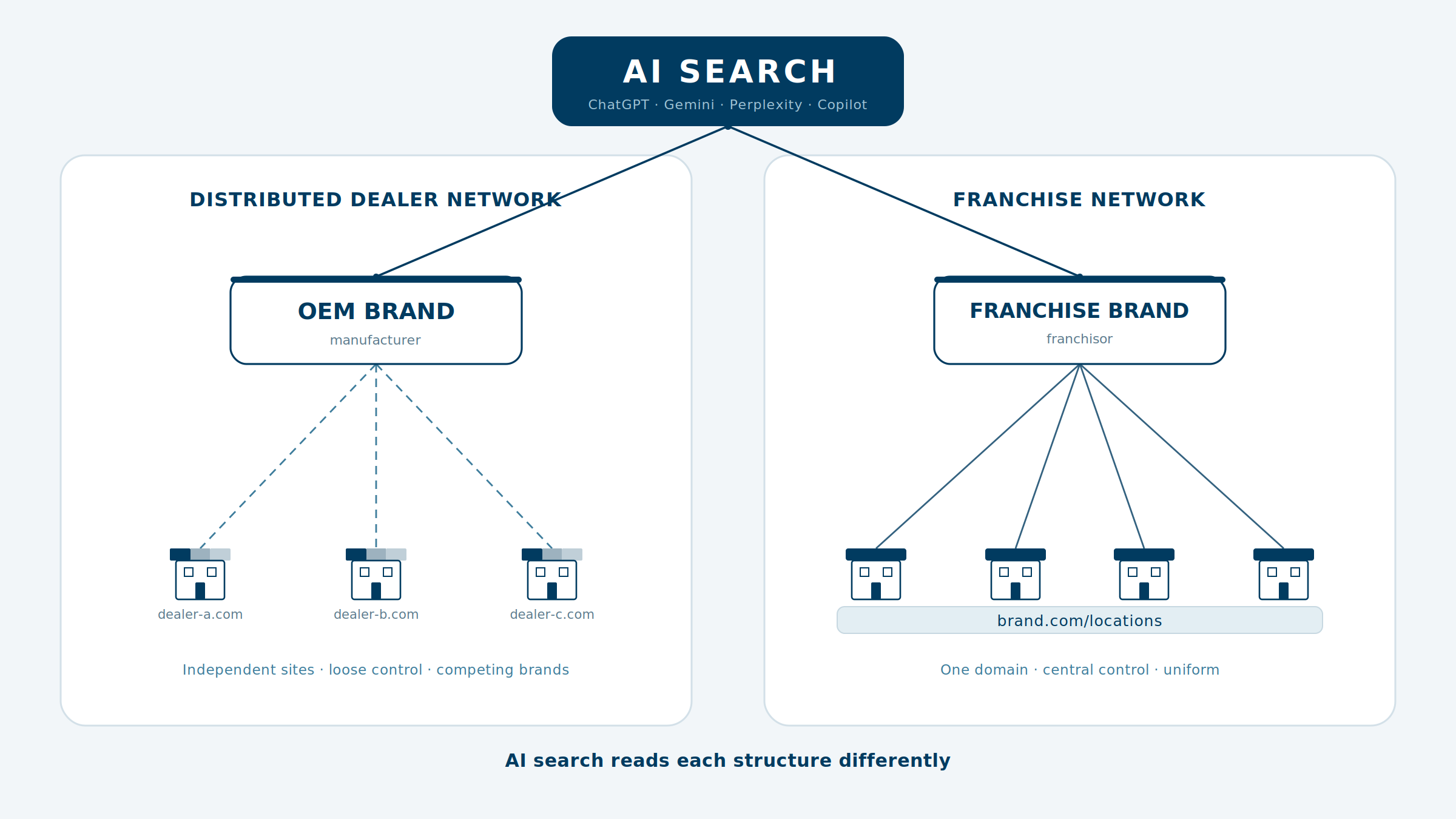
Now picture the structure a franchise, a corporate-owned multi-location business such as a bank or credit union with many branches, or a large dealer group with many of its own rooftops. The brand owns its domain, and every location lives on it: brand.com/locations/location-a, brand.com/locations/location-b, and so on down the network, each location with its own page on the brand's own domain. Each of those location pages is tied to a fully optimized set of directory listings for that specific market, with consistent information synced across every directory. Location A's page on the brand domain matches Location A's Google Business Profile matches Location A's Yelp listing, and the same holds for B, C, D, and every location after them.
When that structure is in place and maintained accurately across the whole network, you are no longer managing a hundred isolated listings. You are building a single, coherent web of signals about one brand operating consistently in a hundred markets. And that is where the compounding starts, because search engines and increasingly AI tools do not evaluate each of those locations in a vacuum. They build an understanding of the brand as a whole from the consistency of its parts.
Why it compounds, specifically
It is worth being precise about why this compounds, because the lazy version of this argument is "more location pages give you more domain authority," and that is not how it works. There is no hidden authority meter that location pages pump up. The real mechanisms are concrete, and they stack on top of each other.
The first is entity consistency. Search engines and AI tools build a model of your brand as an entity, and the confidence of that model depends on how consistent the signals are. When every location's NAP information is identical across every directory and matches the location's page on the brand domain, the brand reads as one coherent, trustworthy entity rather than a scatter of loosely related listings. One location done consistently is a single clean signal. A hundred locations done consistently is a hundred reinforcing signals that all say the same thing about the same brand, and that volume of agreement is qualitatively more convincing than any single listing could ever be.
The second is footprint on one domain. The brand.com/locations structure puts every location's page on the same domain, internally linked to each other and to the brand's core pages. That is not a trick to inflate a score. It is a large, genuinely relevant, internally connected set of pages establishing that this one brand has a real, findable presence across many specific markets. Breadth of relevant, crawlable, interlinked content about local presence is something engines can actually read and weigh, and a network of hundreds of well-built location pages on one domain demonstrates geographic and topical coverage that a handful of pages never could.
The third is citation corroboration. Every location's directory listings cite the brand and point back to that location's page on the brand domain. Across the whole network, that becomes thousands of consistent citations across the directory ecosystem, all corroborating the same brand, the same domain, and the same set of facts. Corroboration is what turns information into confidence, and the local presence backed by thousands of agreeing citations is the one engines and AI tools trust. These are the same local business citations that matter for one location, multiplied and pointed at one coherent target.
Put those three together and the compounding is clear. Consistency makes each location a clean signal, the shared domain ties them into one footprint, and the citations corroborate the whole thing, so each correctly managed location does not just help itself, it strengthens the entity that every other location also belongs to. That is why multi-location SEO at scale is worth more than the sum of its locations, and it is the real version of the argument people are reaching for when they say location pages build authority.
The condition the whole thing depends on
Here is the part that is easy to leave out and dishonest to skip: the compounding only works when it is done right, and at scale, doing it wrong compounds against you just as efficiently.
If your location pages are thin and templated, the same paragraph with the city name swapped out across every market, you are not building a coherent footprint, you are generating duplicate content that drags on the whole domain. If your listings are inconsistent, one address format on Google and another on Yelp, an old phone number lingering on a directory you forgot about, a location that moved but never got updated, you are not corroborating a clean entity, you are feeding the engines conflicting signals that make the brand harder to trust, not easier. At one location, an inconsistency is a small problem. Across hundreds of locations, the same sloppiness replicates into hundreds of conflicting signals, and the scale that should have been your advantage becomes the thing actively confusing the search engines and AI tools you are trying to win.
So the real thesis is not simply "more locations are better." It is that consistency and quality at scale compound in your favor, and inconsistency and thin work at scale compound against you. Which is exactly why this stops being something individual locations can be trusted to handle on their own. A single store managing its own listings can stay accurate. A network of three hundred locations, each left to manage its own listings independently, will drift into inconsistency within months, because there is no human way to enforce that level of consistency by hand across that many markets and directories. The compounding advantage is real, but it is only available to brands that have a system enforcing the consistency that makes it work.
A note on different multi-location structures
One structural distinction matters here, because it changes who captures the compounding. Everything above assumes the locations live on one brand domain. That holds cleanly for franchises, corporate-owned chains, large dealer groups operating many of their own rooftops, and regulated multi-location businesses like banks and credit unions, whose branches live on the institution's own domain in exactly this pattern. For these, the compounding works as described, though financial institutions carry one wrinkle worth naming: banks and credit unions have their own Google Business Profile categories and listing considerations that retail and dealer locations do not, even as the underlying compounding mechanism works the same way.
A manufacturer that sells through independent dealers is a different case. The dealer owns their own website, and often carries competing brands on it, so a manufacturer's dealers usually get a microsite on a subdomain or a separate domain rather than a page on the manufacturer's own domain, and the single-domain footprint effect does not concentrate on the manufacturer the same way. The manufacturer's incentive is more nuanced too, since a dealer's strongest unfiltered listings presence can surface the competing brands that dealer also sells. There is still a real case for a manufacturer helping its dealers optimize their listings in a way that features the brand prominently, because accurate, brand-forward dealer listings do help the brand get found locally. It is simply not the same full-incentive, single-domain compounding that a franchise captures. The brand that captures the full effect in the dealer world is the large dealer group itself, because a multi-rooftop group is a multi-location business in its own right, and every consistently managed rooftop compounds for the group exactly the way it does for a franchise.
Doing this across hundreds of locations
This is the problem PowerStack's microsites and listings management are built to solve together. The microsites side gives every location its own optimized presence, whether that is a page on the brand domain for a franchise or large dealer group, or a microsite on a subdomain for an independent dealer in a distributed network, on brand, accurate, and genuinely differentiated by market rather than templated and thin. The listings side keeps each of those locations synced and consistent across the full directory ecosystem from one place, so the name, address, phone, hours, and categories stay accurate everywhere without anyone chasing each directory by hand. The brand gets centralized control and visibility across the entire network, and each location gets an accurate local presence, which is the brand-to-local model that makes consistency at scale actually achievable instead of merely aspirational. Seeing whether that consistency is holding across every market is its own challenge, which is why listings accuracy belongs in the same view as the rest of a brand's multi-location performance reporting.
That same entity coherence pays off beyond traditional local SEO. As more customers start their search by asking an AI tool like ChatGPT, Google AI Overviews, or Perplexity for a business like yours in their area, those tools rely on the same consistent, corroborated signals to decide which brands and locations to surface and cite. A brand whose locations are coherently and consistently represented at scale is exactly the kind of entity an AI tool can confidently name. If you want to see where your locations currently stand in those answers, our guide on how to check your AI search visibility walks through it.
None of this changes what your locations sell or how good they are. It changes whether customers can find them, whether the brand they belong to reads as one trustworthy entity, and whether the work done in every market adds up instead of canceling out. For a deeper look at how the location pages, the listings, and the tracking fit into a full local strategy, see our guide to SEO for multi-location businesses.
Putting it to work
If you are running marketing for a franchise, a large dealer group, or any brand with locations spread across many markets, the question is not whether listings management matters. It is whether your locations are compounding for you or quietly working against each other. Inconsistent listings and thin location pages at scale are a liability that grows with every location you add. Consistent, well-built ones are an advantage that does the same. PowerChord gives multi-location brands the platform and the team to keep every location accurate, coherent, and pulling in the same direction, so the size of your network becomes the reason you win local search rather than the reason you struggle with it. If you want to see what that looks like across your locations, schedule a demo and we will show you with your own network.
Frequently Asked Questions
What is multi-location listings management?
Multi-location listings management is the practice of keeping every location of a multi-location brand accurately and consistently represented across the directories that feed local search, including Google Business Profile, Bing Places, Apple Maps, Yelp, and dozens of others. For each location, that means the same name, address, and phone number, accurate categories and hours, and a claimed, complete profile. Across a franchise or large dealer group, it also means keeping all of those locations consistent with each other and with each location's page on the brand domain, so the brand reads as one coherent entity rather than a scatter of disconnected listings.
How does listings management compound across many locations?
It compounds because search engines and AI tools evaluate the brand as a whole, not each location in isolation. When every location's information is consistent across every directory and matches the brand's own location pages, three things stack: each location becomes a clean, reinforcing signal about one coherent entity, the location pages form a large connected footprint on a single domain, and the directory citations for every location all corroborate the same brand. One location done right helps that location. A hundred done right reinforce each other and strengthen the brand they all belong to, which is worth more than the sum of the individual locations.
Does adding more location pages improve the brand's domain authority?
Not in the way the phrase suggests. There is no single domain authority score that location pages inflate. What actually happens is more specific: a network of well-built, genuinely differentiated location pages on one domain establishes real geographic and topical coverage, consistent listings across every location corroborate the brand as a trustworthy entity, and the internal links tie it together as one footprint. Those are concrete signals engines can read. But the benefit comes from consistency and quality, not from page count. Adding thin, templated location pages does the opposite, creating duplicate content that works against the domain rather than for it.
What is the best site structure for multi-location listings?
The structure that compounds best is one where every location has its own dedicated page on the brand's own domain, commonly in a pattern like brand.com/locations/location-name, with each page genuinely specific to that market and tied to a consistent, fully optimized set of directory listings for that location. This keeps every location under one domain so the footprint reinforces a single brand, lets each location rank for its own market, and gives the directory citations a consistent place to point back to. The key is that each page is real and differentiated by market, not a template with only the city name changed. For a manufacturer selling through independent dealers, the structure is usually different, since dealers own their own sites, those locations are typically represented through microsites on a subdomain rather than pages on the manufacturer's domain.
What happens if location listings are inconsistent across directories?
Inconsistency works against you, and at scale it does so quickly. A mismatched address, an outdated phone number, or a name format that differs from one directory to the next sends conflicting signals about the brand, which makes search engines and AI tools less confident about which information is correct and less likely to surface and trust the business. For a single location this is a contained problem. Across hundreds of locations, the same sloppiness replicates into hundreds of conflicting signals, so the scale that should be an advantage becomes the source of the confusion. This is why consistency, not just presence, is what makes multi-location listings compound in your favor.
How do franchises and large dealer groups keep listings consistent at scale?
By using a centralized system rather than leaving each location to manage its own listings. Across hundreds of locations and dozens of directories, manual maintenance drifts into inconsistency within months because there is no practical way to enforce that level of accuracy by hand. A platform that syncs each location's information across the full directory ecosystem from one place, paired with a team that maintains it, keeps the network consistent while still giving each location an accurate local presence. This is the brand-to-local model: centralized control and visibility for the brand, accurate representation for every location.
How does multi-location listings management affect AI search visibility?
The same consistency that wins traditional local search also helps a brand show up in AI-generated answers. When customers ask an AI tool like ChatGPT, Google AI Overviews, or Perplexity for a business like yours in their area, those tools rely on consistent, corroborated signals to decide which brands and locations to name and cite. A brand whose locations are coherently represented at scale, with consistent listings and citations all pointing at one trustworthy entity, is exactly the kind of business an AI tool can confidently surface. Inconsistent listings undermine that confidence the same way they undermine traditional local rankings.