.svg "PowerChord-Logo")

A growing share of the people choosing a bank never reach a search results page. They ask ChatGPT which bank to trust in their town, ask Perplexity where to open an account with the best service, or type a question into Google and read the AI Overview that answers before any traditional listing appears. Those answers name specific banks, and the bank that gets named wins the account holder while the others never learn the conversation happened.
For banks that invisibility is especially costly, because the decision being influenced is a long, high-value relationship rather than a single purchase. When an AI tool recommends the bank across town to a prospective account holder, nothing shows up in any report a marketing team currently runs. So the question more bank marketers are asking is the right one: how do we find out whether AI tools mention our bank, and how do we make sure they do. Here is how it works, why banks face a distinct version of the problem, and what to do about it within the constraints banks actually operate under.
Why banks face a harder version of the problem
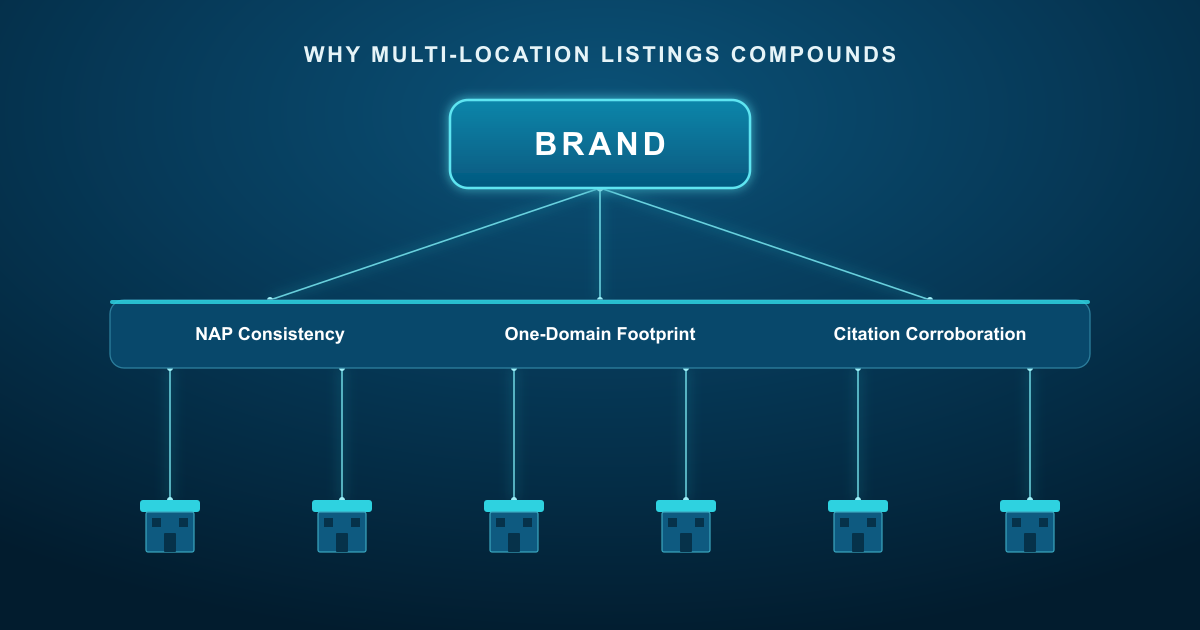
Banks start from a tougher position than most local businesses, for three reasons that compound. First, a bank is rarely one location. A bank with a dozen branches has a dozen local presences that each need to be accurate and findable, and AI tools answer location-specific questions from location-specific data, so a strong brand with neglected branch information still loses the local answer. This is why multi-location SEO is the foundation rather than an afterthought for a bank.
Second, banks operate under compliance and brand-governance constraints that make many of them conservative online, with thin, infrequently updated content and approval cycles that slow everything down, which leaves less for an AI system to draw on than a less-regulated competitor offers. Third, much of a bank's most useful information, the rates, fees, eligibility, hours, and answers account holders actually ask for, often lives in PDFs, images, or vague marketing copy that machines read poorly. None of these are reasons a bank cannot win AI visibility. They are the reasons a bank has to be deliberate about it rather than assuming its size and reputation will carry it.
What AI answers about banks are built from
When an AI tool names banks in an answer, it is not consulting a private ranking. It assembles the response from the information available to it: branch listings distributed across directories and data aggregators, review profiles at each location, structured data on the bank's website, content across the web that answers the question being asked, and third-party sources that corroborate the bank exists and is what it claims to be.
This is why two banks of comparable size and soundness get unequal AI treatment. The one whose branch information is accurate and consistent everywhere, whose reviews are current, and whose website answers questions in plain machine-readable language is easy for an AI system to find and repeat. The one with conflicting branch addresses, stale reviews, and answers buried in PDFs gives the AI nothing reliable to say, so it fills the answer with competitors who offered more. The encouraging part is that this is the same local data layer that has always driven local search, now read by a new kind of reader, which means it is auditable and fixable.
The signals a bank should audit
If a manual check leaves a marketing team unsure where the bank stands, audit the inputs, because they predict the outputs. Start with NAP consistency across every branch: whether each branch's name, address, and phone are identical everywhere they appear, with no duplicate or outdated listings splitting a branch's identity. For a multi-branch bank this is the most common and most fixable failure.
Second, each branch's Google Business Profile: complete, current, correctly categorized, with hours and services maintained, because it is among the most heavily weighted sources for local answers. Third, reviews and their recency, the review velocity at each location, since a steady stream of recent reviews signals an active, trusted branch to both prospective account holders and the machines assembling answers. Fourth, schema markup: the structured data that tells machines explicitly what the bank is, where each branch operates, and what it offers, the difference between an AI inferring the details and reading them. Fifth, content that answers real questions, the pages that respond to what account holders actually ask about rates, eligibility, and switching banks, in plain language rather than locked in documents. Sixth, third-party corroboration, the local business citations and the broader pattern of experience, expertise, authoritativeness, and trust that Google describes as local E-E-A-T, because a bank described consistently by others is treated as more credible than one that only describes itself.
Why your bank might not be showing up
Run the audit and the cause usually surfaces. The most common is inconsistency across branches: the data disagrees with itself, so AI tools either omit the bank or repeat whichever wrong version they ingested. The second is thinness: an accurate but sparse presence, with few reviews, little content, and minimal corroboration, gives an AI nothing substantial to work with, and it reaches for competitors who offered more. The third is structure: banks with genuinely strong reputations whose websites are unreadable to machines, with no schema and key answers trapped in PDFs and images, are under-represented relative to their standing in the community. And sometimes the cause is simply time: data corrected recently takes weeks to propagate through directories and the AI tools' own update cycles, so a bank mid-cleanup may be better than its current AI presence shows.
AEO, GEO, and LLMO for banks
The discipline of improving all this has acquired three overlapping names worth demystifying. Answer engine optimization is structuring content so question-answering tools pull from it. Generative engine optimization is the broader practice of shaping content, data, and online presence so AI search tools reference the bank. Large language model optimization aims at the models themselves, so tools like ChatGPT, Gemini, and Claude describe the bank accurately when they generate answers.
The terminology will keep shifting, but the substance beneath it is stable, and it is the same data work above: consistent branch information, complete profiles, current reviews, structured markup, answer-shaped content, and corroboration. The same foundation that drives local search is what AI systems read, so a provider who pitches AI optimization for banks as something separate from that work is selling the vocabulary rather than the substance.
Doing it within compliance
The constraint that makes banks hesitate, compliance, is real, and it is also manageable. None of the work that drives AI visibility requires a bank to say anything it could not already say. Accurate branch listings, current reviews, structured data, and plainly written answers to common questions are all factual and all within the bounds marketing compliance is built to govern. The practical challenge is process, not permission: review cycles, approved language, and consistency across branches at scale. This is where banks tend to need a partner that understands regulated marketing rather than a generic tool, because the difference between a bank that executes this and one that stalls is usually operational, having the people and the workflow to keep dozens of branches accurate and current under approval, not a question of whether the work is allowed.
What it looks like done right
This is not theoretical. First State Community Bank partnered with PowerChord on exactly this work, and its director of marketing, Sara Bock, describes the result this way: since partnering with PowerChord the bank's digital presence has evolved beyond traditional SEO, its brand is now being surfaced in AI-driven research environments, and it was recognized at a major industry conference as a best-in-class example of AI visibility strategy in action. That is the outcome the audit above is aiming at: a bank that account holders' AI tools actually mention, accurately.
Getting there starts with knowing where the bank stands today. You can run a first check yourself using our guide to checking AI search visibility, and PowerChord's free AI Visibility Report checks whether a bank appears in ChatGPT, Perplexity, and Google AI Overviews, audits the listings accuracy and review signals those answers are built from, and gives one score with a real person walking through the results. From there, AI search visibility reporting inside PowerStack tracks AI-driven traffic and conversions over time, alongside the listings management and reputation programs, run by a team that handles the execution across every branch, that move the underlying signals. For a multi-branch bank operating under compliance, the work that drives AI recommendations and the people who execute it consistently are the whole game, and they are what PowerChord pairs in one place.
Frequently Asked Questions:
How do AI tools decide which banks to recommend?
They assemble answers from the data available about each bank rather than from a fixed ranking: branch listings and their accuracy, review profiles at each location, structured data on the bank's site, content that directly answers account-holder questions, and third-party sources that corroborate the bank. A bank whose information is consistent, current, and machine-readable everywhere is easy for an AI system to cite, while one with conflicting branch data or a thin presence gives it little to work with. The inputs overlap heavily with local search, so banks strong in local SEO fundamentals start with an advantage.
Do all of a bank's branches need to be optimized separately for AI search?
Yes, because AI tools answer location-specific questions from location-specific data. A prospective account holder asking which bank is best in their town gets an answer drawn from the branch information nearest them, so a strong brand with neglected branch listings, reviews, or data still loses the local answer. Each branch needs accurate, consistent listings and an active review presence. The brand sets the standard, but the branches are where AI visibility is actually won or lost, which is why consistency across many locations is the core challenge for multi-branch banks.
Can a bank improve its AI search visibility while staying compliant?
Yes. The work that drives AI visibility, meaning accurate branch listings, current reviews, structured data, and plainly written answers to common questions, is factual and falls within the bounds marketing compliance is built to govern, and none of it requires a bank to say anything it could not already say. The real challenge is operational rather than regulatory: managing review cycles, approved language, and consistency across branches at scale. Banks tend to succeed at this with a partner experienced in regulated marketing rather than a generic tool, because the difference between executing and stalling is usually process, not permission.
How long does it take for a bank to start showing up in AI search?
It is gradual rather than immediate. Corrected listings, new reviews, and updated content take weeks to propagate through directories and the AI tools' own refresh cycles, and AI answers change continually rather than updating on a fixed schedule. A bank that cleans up its branch data and builds its review and content signals typically sees its AI presence improve over the following weeks and months rather than overnight, which is why ongoing measurement matters more than a single check.
What companies help banks show up in AI search?
Providers fall into a few categories. AI visibility monitoring tools track whether a bank appears in AI-generated answers, useful for measurement but not for fixing what they find. Agencies offer answer engine optimization as a service, with depth and financial-industry experience that vary widely. Listings and reputation platforms manage parts of the data layer AI tools draw from. And managed local marketing platforms like PowerChord handle the full input layer for banks, meaning branch listings, reviews, structured data, and content, with AI visibility reporting built in and a team that executes across every branch under compliance, so the work that drives AI recommendations and the measurement of whether it is working live in one place. PowerChord's bank marketing approach is built for multi-branch institutions specifically. The right category depends on whether a bank needs to see the problem, fix one piece of it, or have the whole layer handled across its network.