.svg "PowerChord-Logo")

Knowing what generative engine optimization is and actually doing it are two different things. If you have read up on GEO and checked whether your business shows up in AI answers, the natural next question is what to do about it, and in what order. This guide is the practical version: how to move your business from invisible to cited in tools like ChatGPT, Perplexity, and Google's AI Overviews, the sequence that makes the work pay off fastest, and how to tell whether it is working. It assumes you already understand the concept, so rather than re-explaining what GEO is, it focuses on execution.
One orientation point before the steps. GEO is not a single task you complete, it is a set of signals you build and maintain so AI tools have accurate, plentiful, and consistent evidence to draw on when they answer questions about your category. The work rests on the same foundation that powers local search, organized for how AI systems actually assemble answers. The order matters more than most people expect, because some signals are prerequisites for others, so the steps below are sequenced deliberately rather than listed at random.
Step 1: Know where you stand
Before changing anything, establish a baseline, because you cannot tell whether GEO is working if you never measured the starting point. Run the prompts a real buyer would type into ChatGPT, Perplexity, and Google, and note whether your business appears, how accurately, and who shows up instead. Our guide to checking AI search visibility walks through the manual method in full, so treat that check as step zero rather than repeating it here. Write down what you find, because in a few weeks it becomes the before picture you measure progress against.
Step 2: Fix the data layer first
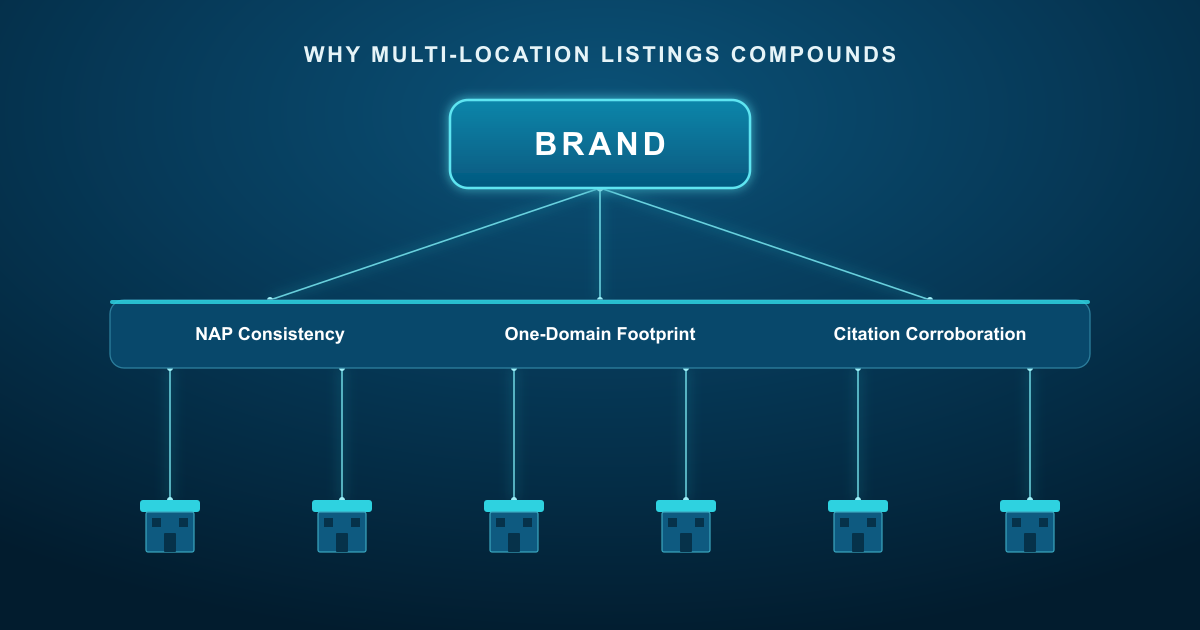
The first real work is the least glamorous and the most important: making your business information accurate and consistent everywhere it appears. AI tools build location-specific answers from your listings across directories and data aggregators, so if your name, address, and phone disagree across sources, or duplicate listings fragment your identity, the AI either omits you or repeats a wrong version. Claim and correct your listings across the major directories, eliminate duplicates, and keep one accurate source of truth, with NAP consistency across every place you appear. This goes first because everything downstream depends on it. There is no point building reviews and content on top of data that contradicts itself, and corrections take a few weeks to propagate through the directories and the AI tools' refresh cycles, which is the main reason to start early.
Step 3: Build a steady stream of reviews
With the data clean, turn to reviews, because they are among the strongest signals both buyers and AI systems use to judge whether a business is active, legitimate, and trusted. Volume matters, but recency matters more: a steady flow of recent reviews signals an active business, while a pile of old ones signals a dormant one. Build a simple, repeatable way to ask satisfied customers at the right moment, and keep your review velocity consistent rather than spiky. Respond to the reviews you get, too, because public review responses show you stand behind your work. This is a flywheel rather than a one-time fix, so the goal is a sustainable cadence, not a single burst.
Step 4: Make your website readable to machines
Now make it easy for AI tools to understand and quote you, and two things do most of that work. First, schema markup, the structured data that states plainly what your business is, where it operates, and what it offers, which is the most direct signal you can send an AI system and the difference between it inferring your details and reading them. Second, content that answers the questions your buyers actually ask, in plain language and in the way they ask them, because answer-shaped content is the raw material AI tools pull from when they construct a response. A thin services page gives an AI nothing to quote, while a page that directly answers a real question gives it something to cite. Make sure your Google Business Profile is complete and current as well, since it is among the most influential local sources an AI tool draws on.
Step 5: Earn outside corroboration
The hardest and slowest step, and the one that separates businesses that merely appear from businesses that get recommended, is third-party corroboration: mentions and citations in sources the AI trusts, including industry publications, local news, and reputable directories. A business the wider web describes consistently is treated as more credible than one that only describes itself, which is exactly the evidence an AI model wants before confidently naming you. This one is relationship-driven and time-driven rather than a setting you toggle, so start it early even though it pays off last.
Step 6: Measure, then maintain
GEO is not a project with a finish line. AI answers change continually, competitors keep working, and your own signals decay if you neglect them, so the final step is to re-run your baseline prompts on a regular cadence, track whether you are appearing more often and more accurately, and keep the data, reviews, content, and corroboration current. Ongoing AI search visibility reporting makes this measurable over time rather than a periodic guess. The businesses that win at GEO treat it as a maintained system, not a one-time cleanup.
Why the order of GEO steps matters
If one thing separates effective GEO from busy work, it is sequence. Fixing the data layer before building reviews and content means you are not amplifying wrong information. Starting corroboration early even though it pays off last means it is maturing while you do everything else. Measuring from a real baseline means you can tell signal from noise later. Plenty of businesses do these tasks in a random order and wonder why nothing moves, when the order itself was the missing piece.
Should you do GEO yourself or hire a partner?
Every step above is doable in-house if you have the time and the discipline to maintain it, and many businesses start exactly that way. The reason most multi-location operators eventually hand it off is not that any single step is hard, it is that the whole thing is continuous and has to happen across every location at once, the data, the reviews, the content, the corroboration, and the measurement, maintained indefinitely. That is the model PowerChord is built on: PowerStack handles the data and structural layer, the accurate listings, NAP monitoring, schema, and reputation signals, while PowerPartner handles the content and authority layer and tracks GEO performance alongside traditional search in one place. If you want to know where you stand before deciding anything, the free AI Visibility Report gives you the baseline from step one with a real person walking you through it.
Frequently Asked Questions:
What is the first step in generative engine optimization?
Establishing a baseline and fixing your data layer. Before anything else, check whether your business currently appears in AI answers so you have a starting point to measure against, then make your business information accurate and consistent across every directory and data source. The data layer comes first because everything else, reviews, content, and corroboration, builds on top of it, and amplifying inconsistent information just spreads the wrong version faster. Only once the foundation is accurate is it worth investing in the signals that sit above it.
How long does it take to see results from GEO?
Weeks to months rather than days. Corrected listings, new reviews, and new content take time to propagate through directories and the AI tools' own refresh cycles, and third-party corroboration, the slowest and most powerful signal, can take months to build. Most businesses that do the work in the right order start seeing their presence in AI answers improve over the following weeks and continue improving over the following months. It is gradual and compounding rather than a switch you flip, which is why starting early and measuring from a baseline both matter.
How do you measure whether your GEO efforts are working?
By re-running the same prompts a buyer would use, on a regular cadence, and tracking whether you appear more often and more accurately than your baseline. Because AI tools do not give you a ranking dashboard, you measure visibility by sampling the actual answers over time: whether you are named, whether the information is correct, and who appears alongside or instead of you. Comparing that against the before picture you captured at the start tells you whether the work is moving the needle. Ongoing reporting makes this systematic rather than an occasional manual spot-check.
Can a business do generative engine optimization on its own?
Yes, every individual step is doable in-house. Claiming listings, asking for reviews, adding schema, writing answer-shaped content, and pursuing mentions are all things a capable marketing team can handle. The difficulty is rarely any single task, it is that GEO is continuous and, for multi-location businesses, has to happen across every location at once and stay maintained indefinitely. Businesses with the time and discipline run it themselves, while those without tend to hand off the ongoing execution, since that is the part that quietly falls behind when it is one responsibility among many.
What are the most common generative engine optimization mistakes?
The most common is treating GEO as a one-time project rather than a maintained system, doing a cleanup once and assuming it holds, when AI answers and competitors keep moving. The second is doing the work in the wrong order, building reviews and content on top of inconsistent listing data, which only amplifies the wrong information. The third is chasing the terminology instead of the substance, buying a tool or service that pitches AI optimization as something separate from the underlying data, reviews, content, and corroboration, when those are the actual levers. And the fourth is underinvesting in reviews, which carry more weight in AI answers than many businesses expect.